Note 231 — Chapter IX · DIYÂRBEKR TO KONIA June 4—July 1
Reading edition
In the low ground there are remains of a theatre, a fine bit of stone wall decorated with good mouldings, and part of a vaulted brick building, possibly a gymnasium. All these are upon the left bank of the stream. The temple upon the bluff was converted at an early date into a church, which has long since fallen into decay, though it has been patched up in recent times by the Armenians (Fig. 228). Along the edge of the bluff there are remains of a columned portico. In the ruined bazaar I saw a couple of beautiful funnel capitals, cracked and broken by fire. They should probably be dated in the early sixth century. At the entrance of the valley that leads up to the Kara Bel are the ruins of a small temple with a finely carved doorway (Fig. 223).
Mr. Hogarth sends me the following note:—
Miss Bell has submitted to me five inscriptions found on a temple site at Comana Capp. They are, she thinks, unpublished, and certainly were not seen by me on either of my visits to Comana in 1890 or 1891. Miss Bell sent me good photographs of nos. 1 and 2; but for the others, I have only her hand-copies to go upon.
No. 1 is a commonplace epitaph, intended to be hexametrical; but the necessary proper names would not accommodate themselves to the metre, and the versifier has had to leave ll. 1 and 3 partly prose. In l. 2 he or the lapicide has made the mistake of leaving the ε before ἡδ unelided. The most interesting point in the inscription, the second name of the dedicator, is, unfortunately, obscured by a breakage of the surface. The lettering is very clear on the photograph except on the right edge.
No. 2 is broken top and right, and the names of the son and mother cannot be restored.
No. 3, the epitaph of a slave set up by his master, offers an instance of the distinction of slaves by the name of the master with a Roman gentile prefix. Either Αὐρ. or Αἰλι. is concealed in Miss Bell’s copy of l. 2. Another slave seems to have appropriated the grave afterwards for his wife, and added a note to that effect.
No. 4 is without points of interest. No. 5 adds to other Oriental names found at Comana Pharnaces and the name of his father, which, in Miss Bell’s copy, reads Giris.
1. Altar-stela with wreaths in relief on the front and sides. The inscription is in careful lettering of about the 4th cent. A.D. Words are in some cases divided by points. Square and round forms are used indifferently, and ligature is frequent. Worn badly on right edge:—
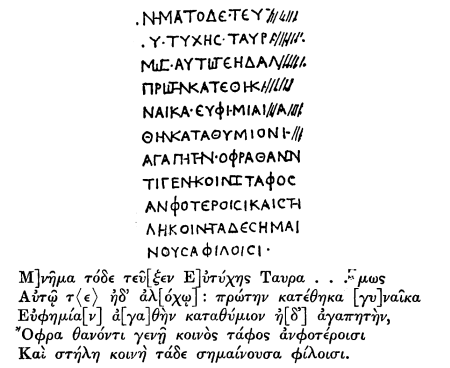
2. Altar-stela with wreath in relief below the inscription. Broken top and right top. Finely-cut lettering of 3rd cent. A.D.:—
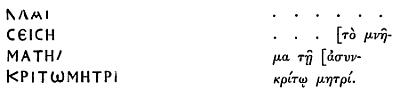
Ἀσύνκριτος: for the use of this epithet at Comana see J. H. S. xviii. p. 318, no. 29, and also no. 4 below.
3. Altar-stela:—
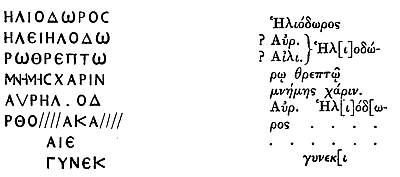
The lines 6-8 may conceal the name Βαιβία borne by the wife of Aur. Heliodorus in an epitaph of Comana published by Waddington from copies by Clayton and Ramsay, Bull. Corr. Hell., vii. p. 137, no. 19.
4. On the rock inside tomb:—

5. On a small stone with rude pediment:—
