Editorial note — Chapter XXXIV
Reading edition
The Author Chronology Sources Parallel text
The following is a little more personal than the average Transcriber’s Note. Given the nature of the book, this may be inescapable.
In classical literature, there is a form called the cento. The word does not mean a hundred of anything; it comes from the Greek word for patchwork. In its original form, the cento takes small pieces of familiar works such as the Aeneid and reassembles the segments—anywhere from a few words to two full lines—into a new text. As rearranged, the content can be anything from saints’ lives to outright obscenity.
With rare exceptions, Alida cannot be called a cento. While some borrowings involve single phrases, most range from to paragraphs to entire chapters. I (the transcriber) first stumbled across the book while searching for the originals of some quoted passages in Alonzo and Melissa. This novel turns out to have been one of Alida’s favorite sources, contributing a solid six-chapter block as well as many shorter segments. Appropriately, Alonzo and Melissa was itself pirated; its credited author did not actually write the book. Conversely, a number of other sources were formally copyrighted—sometimes in the same office where the copyright of Alida was filed.
Only about half the sources (by rough word count) have been identified. Isolated phrases—three or four significant words—were disregarded unless they were very unusual, or from a source quoted many other times. Unidentified sources include:
— most of the longer poetry
— discussions of education (female and general)
— religious material, probably from a then-new denomination such as Baptist or Methodist
— most references to the secondary character Mr. More (apparently from a single source, possibly a subplot in some other book)
If you come across a long passage that you recognize, e-mail lucy2424 at sbcglobal dot net.
One of the few things definitely known about Amelia Stratton Comfield, the author of Alida, is what she looked like in 1852, when her portrait was painted by David Rogers:
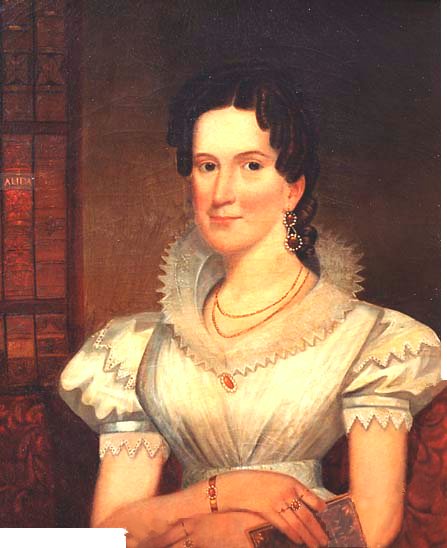
This picture has been altered to align horizontals and verticals and to highlight the two copies of Alida (on bookcase behind subject, and in her hand); this accounts for the jagged edges. At time of preparation (mid-2010), the original was online at the Smithsonian collection.
Amelia Stratton Comfield was probably related to Southern writer and educator Catherine Stratton Ladd (1808–1899), who wrote under a number of pseudonyms—including “Alida”.
The chronology is internally consistent: that is, the passage of time based on descriptions of seasons agrees with datable external events, even in the part of the story that draws heavily on Alonzo and Melissa. The war of 1812 began in mid-1812 and ended in December 1814; evidently the news reached New York before it reached New Orleans.
1811 and earlier
Death of Alida’s mother
Alida goes to seminary in New York:
“The season was now far advanced in autumn”
1812
Alida returns home:
“The spring was advancing”
[June 1812: War declared]
Father’s birthday; Alida is sixteen
From Alonzo and Melissa:
“It was summer, and towards evening when he arrived.”
“It was the beginning of autumn”
“... and sung a requiem to departed summer”
“... the day had been uncommonly sultry for the autumnal season”
“Winter came on; it rapidly passed away.”
1813
“Spring advanced, and the marriage day was appointed.”
“Nature was adorned with the bridal ornaments of spring”
“Fleecy summer clouds ...”
Theodore has not yet enlisted
“... weary summer had lapsed into the fallow arms of autumn”
After father’s remarriage:
“the cool breezes of autumn had changed to the hoarse murmuring gales of winter”
1814
“the mild and salubrious breezes of spring had succeeded to the blustering gales of winter”
Father’s birthday
[August 1814: burning of Washington]
[December 1814: Treaty of Ghent]
[December 1814-January 1815: Hartford Convention]
“... taken up their residence in the city for the winter”
1815
[January 1815: battle of New Orleans]
War is over; celebration of peace
“winter’s snow was passing from the face of nature”
“verdant scenery of spring”
“showers of April had cleared the atmosphere”
Father’s birthday
Alida leaves for tour of New York state:
“The summer was past its meridian”
“The number of travellers this summer were unusually great”
1816
After death of Alida’s father:
“at the commencement of the ensuing spring”
Theodore returns
Abbreviated titles of the most frequently cited works are given here in boldface. Unless otherwise noted, the quoted edition was picked simply because it was the most readily available; it may or may not have been the edition used by the author. All [sic] notations were added by the transcriber; all brackets in Alonzo and Melissa are in the original.
Sources that are used only once are identified as they occur in the text.
Karl Bernhard, Duke of Saxe-Weimar-Eisenach: Travels through North America, during the years 1825 and 1826. Translation published 1828. “Travels”
Chapters XXIV-XXVII inclusive, except the poetry, are taken from this book. See beginning of chapter XXIV for more information.
John Warner Barber: Interesting Events in the History of the United States ... (exact title varies). First edition 1827; later editions include 1828 and 1834, with reprints of each. Details of wording point to the 1828 edition as the source.
The segments dealing with the war of 1812 are quoted extensively: “Second War with Great Britain”; the battles of Queenstown, Lake Erie, Niagara and Lake Champlain; Death of Tecumseh; the Hartford Convention; “Piracies in the West Indies”.
Nathaniel Dwight: Sketches of the lives of the Signers of the Declaration of Independence. First Edition 1830; quotations from 1840 edition (reprint of 1830). “Lives of Signers”
Used primarily for character descriptions. Most are applied to male characters in the novel, but one passage is inserted into a description of Dolly Madison. With one exception, all selections are taken from representatives of Northern states.
Mrs. James Madison. Here quoted from The American Magazine of Useful and Entertaining Knowledge; the article was printed in other publications.
Some parts of this article refer to the period when James Madison was Secretary of State under Jefferson.
Much of the article quotes from the chapter on Dolly Madison in a longer work: American Academy of the Fine Arts (James Herring and James Barton Longacre), The National Portrait Gallery of Distinguished Americans (no later than 1834).
A sketch of the life and public services of William H. Harrison, commander in chief of the North-western army during the War of 1812, &c. Many editions from 1835 and later.
Charles Phillips: Speech at Dinas Island on George Washington. Widely reprinted; the version published in the author’s Collected Speeches is different from earlier published versions quoted here.
Lindley Murray: The Power of Religion on the Mind. First edition 1836; many later editions and reprints. Quotations from 1863 (the only edition available to me).
Not a religious work but a collection of short biographies with character description. Except for the article on Job, attributions are too short to be certain; Alida may have found similar phrases in a different source.
Francis Smith Eastman: A history of the state of New York ... First edition 1828; later edition (with reprints) 1831. Details of wording identify the 1831 edition (or a later one) as the source.
By word count, Alida’s favorite source: chapters VII-XII inclusive, much of the adjoining chapters VI and XIII, most of XXXIII-XXXIV (the final two chapters), and many other passages of varying length. See beginning of chapter VI for more information.
Regina Maria Roche: The Children of the Abbey. First published 1796, reprinted throughout the following century. Quotations from 1877.
Mrs. (Mary Martha) Sherwood: The Broken Hyacinth; The Lady of the Manor.
Alida may contain other quotations from this author; most phrases are too short to be unambiguous. Mrs. Sherwood’s fiction has a strong religious element, and she seems the kind of author Amelia Comfield would have liked.
Robert Folkestone Williams: Mephistophiles in England, or the Confessions of a Prime Minister. 1835.
Alida only quotes one passage from this two-volume novel. The episode may have been reprinted in some other text, or the novel itself may have lifted it from an earlier source.
Amelia Stratton Comfield: Alida.
When all else fails, the book quotes itself. One passage appears three times.
The New-York Weekly Magazine, Or, Miscellaneous Repository: Volume II, 1797. Reprinted as a single bound volume containing 52 8-page issues (July 1796-June 1797). “NY Weekly”
Only two volumes of this periodical, and a few issues of the third, were published; only volume II was available to me. At least 30 separate pieces are quoted in Alida, so it is likely that some unidentified sources are in volumes I or III.
Most essays were printed with minimal attribution, or none at all; some can also be found in other sources. “The Nettle and the Rose” also appears in The Blossoms of Morality (1796) and in New-York Magazine, N.S. II (1797). “On Education” is taken from the writings of Vicesimus Knox; “Detraction” is by Nathaniel Cotton.
“Amelia, or the Faithless Briton”. Here quoted from The New-York Magazine, or, Literary Repository: Vol. VI (1795); the story also appears in The Lady’s Weekly Miscellany (1810).
“The Merchant’s Daughter”. Here quoted from The American Monthly Magazine, Vol. 3, 1834.
“The Story of an Unfortunate Young Lady”. Here quoted from The Lady’s Miscellany, or, Weekly visitor... Vols. 14–15 (1811)
Most poems are quoted only once, and will be identified as they appear. The author of Alida was obviously fond of poetry, especially obscure poems found in periodicals or privately published books.
James Thomson (d. 1748): The Seasons. The work was reprinted many times. Quotations are from the 1829 Hartford edition.
There exists an 1842 edition of The Seasons which also contains Bloomfield’s Farmer’s Boy (see chapter XIV). If similar collections were published earlier, this might be the source for both poems.
In Alida, passages from The Seasons are almost always in quotation marks.
Mary (Mrs. Henry) Tighe: Psyche, with Other Poems. Quoted from 1816 London edition.
Quoted works: Verses Written at the Commencement of Spring (1802); Verses Written in Sickness (1804); A Faithful Friend is the Medicine of Life.