Note 22 — Chapter VIII
S. R. (Sylvester Rosa) Koehler translation
(p. 59.) If there is no plate-printer near you, but you have access to a lithographic printing establishment, you can have your proofs taken there. “Lithographic presses,” says A. Potémont, “give perfectly good and satisfactory proofs of etchings.”
Not every printer can print an etching as it ought to be printed. A man may be an excellent printer of line engravings and mezzotints, and yet may be totally unfit to print an etching. I would recommend the following printing establishments:—
New York: Kimmel & Voigt, 242 Canal Street. Boston: J. H. Daniels, 223 Washington Street.
If you desire to establish an amateur printing-office of your own you will need, in addition to the tools and materials already in your possession:—
A press,A dabber or ball,
A plate-warmer,Rags for wiping,
An ink-slab,Printing-ink,
A muller,Paper.
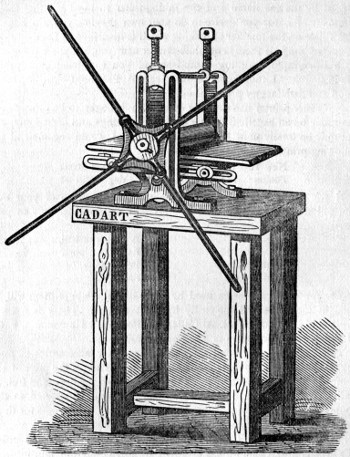
The press. The presses used by professional plate-printers will be thought too large and too costly by most etchers. There is a small press sold by Madame Ve. A. Cadart, 56 Boulevard Haussmann, Paris, of which a representation is given on the next page.
This press, accompanied by all the necessary accessories,—rags, ink, paper, plate-warmer, dabber, etc.,—sells in Paris at the price of 150 francs (about $30). There is an extra charge for boxing; and freight, duties, etc., must also be paid for, extra, on presses imported to this country. The publishers of this book are ready to take orders for these presses, but I cannot inform the reader what the charges will amount to, as no importations have yet been made by Messrs. Estes & Lauriat.
There is also a small press invented by Mr. Hamerton and made in London by Mr. Charles Roberson, 99 Long Acre, which sells on the other side, for the press only, at two guineas for the smallest, and four guineas for a larger size. These presses are smaller than the Cadart presses, and, according to Mr. Hamerton, are “very portable affairs, which an etcher might put in his box when travelling, and use anywhere, in an inn, in a friend's house, or even out of doors when etching from nature.”
A small press has also quite lately been introduced by Messrs. Janentzky & Co., of Philadelphia, which costs only $16.50 (without accessories), and is well recommended by those who have used it.
The press is not complete without the flannels spoken of in the text (p. 56, § 87). There is a kind of very thick flannel specially made for printers' use. But if this cannot be had (of some plate-printer) any good flannel with a piece of thick soft cloth over it will do well enough.
In adjusting the press care must be taken that the pressure is neither too great nor too small. This is a matter of experience.
The plate-warmer is a box made of strong sheet-iron, into which either a gas-jet or a small kerosene lamp can be introduced. If you happen to have a gas-stove, and can get an iron plate of some kind to lay across the top, you will have an excellent plate-warmer.
The ink-slab. Any smooth slab of marble, slate, or lithographic stone, about a foot square, will do.
A muller. This is a pestle of stone, flat at the bottom, used for grinding colors or ink.
A dabber or ball. Take strips of thick cloth or flannel, about four or five inches wide; roll them together as tightly as possible, until you have a cylinder of two or three inches in diameter; bind firmly by strong twine wound all around the cylinder; then cut one end with a large sharp knife, so as to get a smooth surface. After the dabber has been used for some time, and the ink has hardened in it, cut off another slice so as to get a fresh surface.
Rags for wiping. Fine Swiss muslin and the fabric known as cheese cloth make good rags for wiping. They can be bought at the dry-goods stores. As they are charged with some material to make them stiff and increase the weight, they must be washed before they are used. When they have become too much charged with ink they may be boiled out in a solution of potash or soda in water. The Swiss muslin costs about twelve cents a yard, the cheese cloth about five.
I had a lot of rags specially sent to me from Paris, as I wished to see the difference between the soft and the stiff muslin. The parcel contained a collection of pieces of a sort of Swiss muslin, evidently old curtains, and some pieces of old cotton shirting, some of which had done duty at the Hôtel des Invalides, still bearing its stamp!
Printing-ink and paper. (See Notes [23] and [24].)
To ink the plate, place it on the plate-warmer and allow it to become as hot as your hand can bear. Then take up the ink from the ink-slab with the dabber and spread it all over the surface, moving the dabber along with a rocking motion, but not striking the plate with it. Take care that the lines are well filled. Sometimes, in the first inking of the plate, it is necessary to use the finger to force the ink into the lines.
In wiping the plate the first operation is to remove all the superfluous ink from the surface by means of a rag. What follows depends on the kind of impression you desire to get. If you want a natural, clean, or dry proof, as these impressions are variously called (i. e. an impression which shows only black lines on a perfectly clear white ground), charge the palm of your hand with a very little whiting or Spanish white, and with it finish the wiping of the plate. This operation will leave the surface of the plate perfectly clean and bright, while the ink remains in the lines. If you desire to have an even tint left all over the plate, avoid the use of the hand, and wipe with the rag only. Plate-printers use their rags moist, but for printing etchings a dry rag is preferable, as it leaves more of a tint on the plate. Note, also, that the rag must be tolerably well charged with ink to enable you to wipe a good tint with it.
The margin of the plate, even if a tint is left over it, must always be wiped clean. This is best accomplished by a bit of cotton cloth charged with whiting.
For the rest, nothing is left but to experiment according to the hints given in the text by M. Lalanne.