Note 87 — Chapter VII · KEPLER.
Reading edition
An ellipse is one of several curves, known as conic sections, which can be formed by taking a section of a cone, and may also be defined as a curve the sum of the distances of any point on which from two fixed points inside it, known as the foci, is always the same.
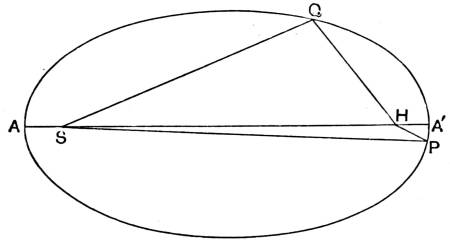
Fig. 59.—An ellipse.
Thus if, in the figure, S and H are the foci, and P, Q are any two points on the curve, then the distances S P, H P added together are equal to the distances S Q, Q H added together, and each sum is equal to the length A A′ of the ellipse. The ratio of the distance S H to the length A A′ is known as the eccentricity, and is a convenient measure of the extent to which the ellipse differs from a circle.