Note 21 — Chapter I · DENTAL ART AMONG THE EGYPTIANS.
Reading edition
The incisors represented in the cut of Renan’s work do not at all give the anatomical form of upper incisors, but of lower ones. Therefore, either the figure itself has been badly drawn, or the piece found by Dr. Gaillardot was part of the inferior and not of the superior jaw. In the latter case, the figure in Renan’s book ought to be reversed, in the manner here shown:
Fig. 4
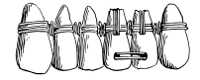
The same figure reversed, as it ought to be if the piece found at Sidon belonged to a lower jaw.
Fig. 5 Fig. 6
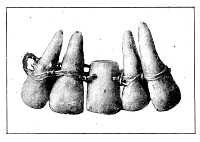
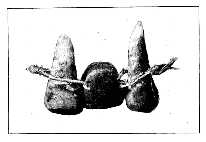
Examples of dental prosthesis as practised by the Hindus at the present time.
Neither do we understand on what ground Dr. Gaillardot has based his affirmation of the piece discovered having belonged to a female skeleton, as it is well known that there is no characteristic difference between a male and a female jaw.
[Interesting examples of the survival of this primitive type of dental prosthesis are found among the Hindus at the present time. The two illustrations (Figs. 5 and 6) are from photographs of specimens of work done by native Hindu dentists. Fig. 5 is a roughly carved artificial tooth of ivory attached by a gold wire ligature to the adjacent natural teeth, all of which, with the artificial tooth attached, were subsequently lost by alveolar disease. Fig. 6 is a similar carved artificial tooth of ivory attached to the adjoining teeth by a thread ligature, the supporting teeth with the attached ivory tooth also having been lost by alveolar disease. These specimens were removed and sent to the writer by Dr. H. B. Osborn, of Burma, during the present year (1909).—E. C. K.]