Note 1 — VOLUME III.
Reading edition
See vol. ii. p. 421.
2 [Of this PORTRAIT, which may be truly said to enrich the pages of the previous edition of the Tour, a more liberal use has been made than I was prepared to grant. My worthy friends, Messrs. Treuttel, Würtz, and Richter were welcome to its republication; but a third edition of it, by another hand, ought not to have been published without permission. The ORIGINAL of this Portrait has ceased to exist. After a laborious life of fourscore years, the learned Schweighæuser has departed--in the fullest maturity of reputation arising from classical attainments; to which must be added, all the excellences of a mild, affable, christian-like disposition. As a husband, a father, and a friend, none went before him: no one displayed these domestic virtues in a more perfect and more pleasing form. As a Greek Scholar and Commentator, he may be said to rank with Hemsterhusius, Wyttenbach, and Heyne. He was equally the boast of Strasbourg and the glory of his age. Never was profound learning more successfully united with "singleness of heart," and general simplicity of character. He ought to have a splendid monument (if he have it not already?) among his Fellow Worthies in the church of St. Thomas at Strasbourg. PEACE TO HIS ASHES!]
3 For the first time, my bill (which I invariably called for, and settled, every day) was presented to me in a printed form, in the black letter, within an ornamented border. It was entitled Rechnung von Gottlob Ernst Teichmann, zum Waldhorn in Stuttgart. The printed articles, against which blanks are left, to be filled up according to the quantity and quality of the fare, were these: Fruhstuck, Mittag-Essen, Nacht Essen, Fremder Wein, Ordinarier Wein, Verschiedenes, Logis, Feuerung, Bediente." I must be allowed to add, that the head waiter of the Waldhorn, or Hunting Horn, was one of the most respectably looking, and well-mannered, of his species. He spoke French fluently, but with the usual German accent. The master of the inn was coarse and bluff, but bustling and civil. He frequently devoted one of the best rooms in his house to large, roaring, singing, parties--in which he took a decided lead, and kept it up till past midnight.
4 [The late Duchess of OLDENBURG.]
5 See vol. ii. p. 356.
6 [This Public Library is now pulled down, and another erected on the site of it.]
7 In one of these copies is an undoubtedly coeval memorandum in red ink, thus: "Explicit liber iste Anno domini Millesio quadringentissimo sexagesimosexto (1466) format9 arte impssoria p venerabilem viru Johane mentell in argentina," &c. I should add, that, previously to the words "sexagesimosexto" were those of "quiquagesimosexto"-- which have been erased by the pen of the Scribe; but not so entirely as to be illegible. I am indebted to M. Le Bret for the information that this Bible by Mentelin is more ancient than the one, without date or place, &c. (see Bibl. Spencer, vol. i. p. 42, &c.) which has been usually considered to be anterior to it. M. Le Bret draws this conclusion from the comparative antiquity of the language of Mentelin's edition.
8 This was the second copy, with the same original piece, which I had seen abroad; that in the Library of the Arsenal at Paris being the first. I have omitted to notice this, in my account of that Library, vol. ii. p. 156-7, &c.
9 [Both volumes will be found particularly described in the Ædes Althorpianæ, vol. ii. p. 285-290.]
10 Lord Spencer has recently obtained a PERFECT COPY of this most rare edition--by the purchase of the library of the Duke di Cassano, at Naples. See the Cassano Catalogue, p. 116.
11 A very particular description of this rare edition will be found in the Bibl. Spencer, vol. ii. p. 141.
12 See the Bibliographical Decameron, vol. i. p. cxcviii.
13 See vol. ii. p. 73.
14 See Ottley's History of Engraving, vol. i. p. 86; where a fac-simile of this cut is given--which, in the large paper copies, is coloured.
15 See vol. ii. p. 134-5.
16 The SFORZIADA: See the Catalogue of his Library, no. 7559.
17 The prologue of this metrical life begins thus:
Ecce tuis parui uotis uenerande sacerdos Cor quia de vro feruet amore mihi Pontificis magna wilbroodi et psulis almus Recurrens titulis inclyta gesta tuis Sit lux inferior strepitant cum murmure rauco illius egregi9 sermo meus meritis
This life consists of only 11 leaves, having 23 verses in a full page. It is printed in the Lect. Antiq. of Canisius, vol. ii. p. 463; and the prose life is printed by Surius and by Mabillon.
18 Before described in the Bibl. Spenceriana; vol. IV. p. 508.
19 The book in question has the following colophon:
Hoc opus exiguum perfecit rite iohannes Fabri: cui seruat lingonis alta lares. Ac uoluit formis ipsum fecisse casellis. M.cccc.lxxcii de mense maii.
The s is very singular, being smaller than the other letters, and having a broken effect. This copy, in the Public Library at Stuttgart, is not bound, but in excellent condition.
20 Afterwards Sir Alexander Allan, Bart. I met him and Captain C * * *, of the Royal Navy, in their way to Inspruck. But Sir Alexander (than whom, I believe a worthier or a braver man never entered the profession of which he was so distinguished an ornament) scarcely survived the excursion two years.
21 The Queen of Würtemberg survived the levee, above described, only a few months. Her DEATH was in consequence of over-maternal anxiety about her children, who were ill with the measles. The queen was suddenly called from her bed on a cold night in the month of January to the chamber where her children were seriously indisposed. Forgetful of herself, of the hour, and of the season, she caught a severe cold: a violent erysipelatous affection, terminating in apoplexy, was the fatal result--and SHE, who, but a few short-lived months before, had shone as the brightest star in the hemisphere of her own court;--who was the patroness of art;--and of two or three national schools, building, when I was at Stuttgart, at her own expense--was doomed to become the subject of general lamentation and woe. She was admired, respected, and beloved. It was pleasing, as it was quite natural, to see her (as I had often done) and the King, riding out in the same carriage, or phaeton, without any royal guard; and all ranks of people heartily disposed to pay them the homage of their respect. In a letter from M. Le Bret, of the 8th of June 1819, I learnt that a magnificent chapel, built after the Grecian model, was to contain the monument to be erected to her memory. Her funeral was attended by six hundred students from Tubingen, by torch light.
22 For the sake of juxta-position, I will here mention the SEQUEL, as briefly as may be. The "affair" was far from being at that time "settled." But, on reaching Manheim, about to recross the Rhine, on my return to Paris--I found a long and circumstantial letter from my bibliographical correspondent at Stuttgart, which seemed to bring the matter to a final and desirable issue. "So many thousand francs had been agreed upon--there only wanted a well bound copy of the Bibliographical Decameron to boot:--and the Virgils were to be considered as his Lordship's property." Mr. Hamilton, our Chargé d'Affaires, had authority to pay the money--and I ... walked instantly to Artaria's--purchased a copy of the work in question, (which happened to be there, in blue morocco binding,) and desired my valet to get ready to start the next morning, by three or four o'clock, to travel post to Stuttgart: from whence he was not to return without bringing the VIRGILS, in the same carriage which would convey him and the Decameronic volumes. Charles Rohfritsch immediately prepared to set out on his journey. He left Manheim at three in the morning; travelled without intermission to Stuttgart,--perhaps fourscore or ninety miles from Manheim--put up at his old quarters zum Waldhorn (see p. 17, ante.) waited upon M. Le Bret with a letter, and the morocco tomes--RECEIVED THE VIRGILS--and prepared for his return to Manheim--which place he reached by two on the following morning. I had told him that, at whatever hour he arrived, he was to make his way to my chamber. He did as he was desired. "LES VOILA!"-- exclaimed he, on placing the two volumes hastily upon the table.--"Ma foi, Monsieur, c'est ceci une drôle d'affaire; il y a je ne sçai pas combien de lieues que j'ai traversé pour deux anciens livres qui ne valent pas à mes yeux le tiers d'un Napoleon!" I readily forgave him all this saucy heresy--and almost hugged the volumes ... on finding them upon my table. They were my constant travelling companions through France to Calais; and when I shewed the Adam Virgil to M. Van Praet, at Paris--"Enfin (remarked he, as he turned over the broad-margined and loud-crackling leaves) voilà un livre dont j'ai beaucoup entendu parler, mais que je n'ai jamais vu!" These words sounded as sweet melody to mine ears. But I will unfeignedly declare, that the joy which crowned the whole, was, when I delivered both the books ... into the hands of their present NOBLE OWNER: with whom they will doubtless find their FINAL RESTING PLACE. [Such was my bibliographical history--eleven years ago. Since that period NO copy of EITHER edition has found its way into England. "Terque quaterque beatus!"]
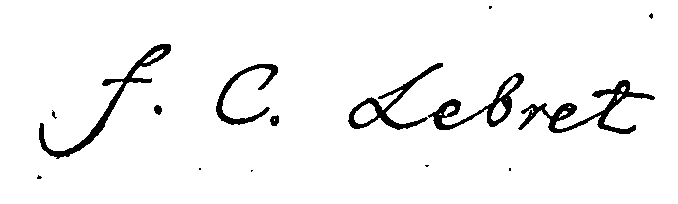
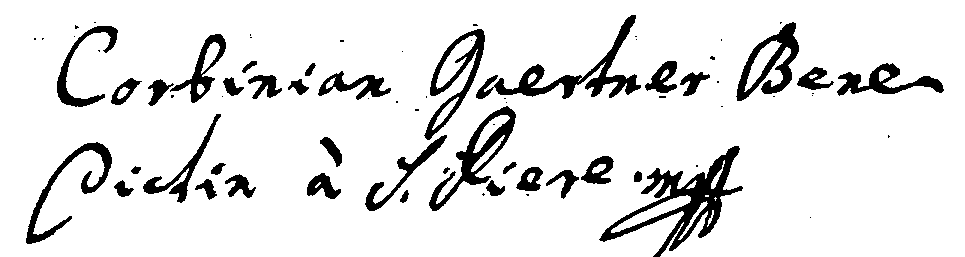
23 [Several years have elapsed since I have received a letter from Mons. Le Bret. Is he alive? If he be living, let him be assured of my unalterable and respectful attachment: and that I have unfeigned pleasure in annexing a fac-simile of his AUTOGRAPH--from a letter to me of the date of June 8th 1819: a letter, which I received on the 17th of the same month following--the very day of our Roxburghe Anniversary Dinner. Singularly enough, this letter begins in the following strain of bibliographical jocoseness: "Monsieur, et très reverend Frère de Boocace l'Immortel!"]
24 The predominant religion is the Protestant. Indeed I may say that the number of Catholics is exceedingly limited: perhaps, not an eighth part of the population of the town.
25 I presume this to be the earliest date which any of his books exhibit. His brother GUNTHER, or GINTHER (for the name is spelt both ways in his colophons) began to print in 1468. Lord Spencer possesses a beautiful copy (which I obtained from the library of St. Peter's Monastery, at Salzbourg) of Bonaventure's Meditations upon the Life of Christ, of the date of 1468, printed by G. Zainer, or (Zeiner) at Augsbourg; and considered to be the first effort of his press.
26 The note, above mentioned, was written in Latin: the Professor telling me that he preferred that language to the French, as he thought he could write it more grammatically. A Latin note must be rather a curiosity to my readers: which, as it is purely bibliographical, and in other respects highly characteristic of the bon-hommie of the writer, shall receive a place here. After mentioning the books above specified, the Professor goes on thus:
"Haec paucula e pluribus notare libuit, quæ reliqua temporis angustia ostendere non permisit. Habeo enim alias, quas vocant, editiones principes, e.g. Diogenis Laertii, Bas. 1533-4. Josephi, Bas. 1544. fol. Jo. Chrysostomi
"Pauculos Codd. MSS. e. gr. Ciceronis de Officiis, Aratoris in Acta App. Fragmenta Liuii et Terentii ostendere tempus non concessit: præter eos habeo aliquot Ciceronis Orationes, Excerpta ex Liuio, duos Historiæ Griseldis, et alios minoris pretii.
"Maximam collectionis, Bibliothecam appellare non fas est, meæ partem efficit magnus librorum et libellorum numerus ab Ao. 1500. usque ad 1550. editorum a Reformatoribus eorumque aduersariis, qui numerum sex millium superant, in quibus adsunt Serueti de Trinitatis erroribus, eiusdemque Dialogi, Tomi Pasquillorum, Henr. Corn. Agrippæ aliquot opera, Lemnii Epigrammata, aliquot libelli, Lutheri et Melancthonis manu ornati; præterea alia Collectio Documentorum, quorum antiquissimum est ab. A. 1181 et Epistolarum
"Sed nolo longiore enarratione molestus esse, ne vanus esse uidear, a quo vitio nemo me alienior est. Vt divina providentia iter prosperum esse iubeat, est, quod ex animo TIBI, VIR--precatur
Vlmæ, Aug. MDCCCXVIII.
P.S. Et TIBI præsenti, et superiora heri nocte et somno ingruente scribens referre omiseram, esse mihi ex XXII. libris ab Academia Veneta, della Fama dicta, editis XV. Omnes adeo sunt rari, ut vel instructissimæ bibliothecae vix aliquot eorum habeant. Addo germanicam Sixti Papæ Bullæ datæ 1474 versionem, sine dubio Vlmæ eodem anno impressam, et quinque foliis constantem; quam apud me vidisti."
The Professor, with the above note, was also so obliging as to present me with a copy of his "Specimen Historico-Litterarium de Academia Veneta. Qua Scholarchæ et Vniversum Gymnasii quod Ulmæ floret Consilium Mæcenates Patronos Fautores ejusdem Gymnasii ad Orationem aditialem A.D. XXIV. Febr. A. 1794, habendam officiose atque decenter invitant."--A Latin brochure of twelve pages: "Ulmæ ex Officina Wagneri, Patris."
27 [There is an excellent lithographic print of this Rath Haus, which I possess.]
28 The postboys in the Duchy of Baden, and in the territories of Würtemberg, have also horns; but I never could get any thing, in the character of a tune, performed by either of them. The moment you enter BAVARIA, you observe a greater elasticity of character. [The ARMS of Bavaria head the first page of this third volume of my Tour.]
29 The reader may try the effect of perusing the following articles (taken from this printed catalogue) upon his own muscles. The performance, as I suspect, is by a native of Augsbourg.
75. Portrait of Justus Lipsius by Rembrand. This head of a singulary verity shews of draughts of a man of science: the treatement of Clothing is most perfectful, the respiring of life, the hands all wunder-worthy to be admired. 208. A hunting- piece of great beauty by Schneyders, the dogs seem to be alife, the wild-fowls, a hare, toils, just as in nature. 341. Queen Marie Christine of Sweden represented in a very noble situation of body and tranquility of mind, of a fine verity and a high effect of clair-obscure. By Rembrand. 376. Cromwell Olivier, kit-cat the size of life, a Portrait of the finest carnation, who shews of a perfect likeness and verity, school of Vandyk, perhaps by himself. 398. Portrait of Charles the first king of England (so many Portraits of famous persons by Classick painters will very seldom be found into a privat collection) good picture by Janson van Miereveld. 399. A large and precious battle piece representing a scene of the famous victory by Blindheim wonen by Marleborough over the frensh 1704. We see here the portrait of this hero very resembling, he in a graceful attitude on horsebak, is just to order a movement: a many generals and attendance are arround him. The leaguer, the landscape, the groups, the fighting all with the greatest thruth, there is nothing that does not contribute to embellish this very remarcable picture, painted by a contemporary of the evenement and famous artist in battle pieces, George Philipp Rugendas.
30 This was no uncommon representation in the early period of art. "In the church of St. Peter the Younger, at Strasbourg, about the year 1515, there was a kind of large printed placard, with figures on each side of it, suspended near a confessional. On one side, was a naked Christ, removing the fire of purgatory with his cross, and sending all those, who came out of the fire, to the Pope--who was seated in his pontifical robes, having letters of indulgence before him. Before him, also, knelt emperors, kings, cardinals, bishops and others: behind him was a sack of silver, with many captives delivered from Mahometan slavery--thanking the supreme Pontiff, and followed by clergymen paying the ransom money to the Turks. There might also be seen captives, at the bottom of a deep well, shut down by bars of iron; and men, women, and children, making all manner of horrible contortions. "Those, says the chronicler Wencker, "who saw such a piteous sight, wept, and gave money liberally--for the possession of indulgences;--of which the money, raised by the sale, was supposed to be applied towards the ransom of Christian captives." HERMANN; Notices Historiques, &c. de Strasbourg: vol. ii. p. 434.
31 His account of the PRINTED BOOKS in the XVth century, in the monastery above mentioned, was published in 1786, in 2 vols. 4to. That of the MANUSCRIPTS, in the same monastic library, was published in 1791, in 2 vols. or rather perhaps, six parts, 4to.
32 Among the books in this monastery was an uncut copy of the famous edition of the Meditationes J. de Turrecremata, of the date of 1467, which is now in the Library of Earl Spencer. In Hartmann Schedel's Chronicon Norimbergense, 1493, fol. CLXII, are portraits of the Founders of the Town and Monastery of Eichstadt, or EISTETT; together with a large wood-cut view of the town. This monastery appears to have been situated on a commanding eminence.
33 [This Abbey was questionless one of the most celebrated and wealthy in Europe. The antiquarian reader will be pleased with the OPPOSITE PLATE--presenting a bird's eye view of it, in the year 1619--(when it stood in its pristine splendour) from the Monasteriologia, attached to the Imagines Sanctorum.]
34 In the BAVARIA SANCTA of RADERUS, 1615-27, 3 vols. folio, will be found a succession of martyrological details--adorned by a series of beautiful engravings by Ralph Sadeler. The text is in Latin, and the author has apparently availed himself of all the accessible authorities, in manuscript and print, which were likely to give interest and weight to his narrative. But it seems to have been composed rather for the sake of the ENGRAVINGS--which are generally most admirably executed. Great delicacy and truth of drawing, as well as elegance of grouping, are frequently discernible in them; and throughout the whole of the compositions there is much of the air of Parmegiano's pencil; especially in the females. Sadeler makes his monks and abbots quite gentlemen in their figures and deportment; and some of his miracles are described with great singularity and force of effect.
35 Such is ZAPF'S work, entitled Annales Typographiæ Augustanæ, 1778; 4to. republished with copious additions in 1786, two volumes, 4to. The text of the latter is (unfortunately, for the unlearned) printed in the German language.
36 [This Latin Bible came from the Eichstadt Monastery.]
37 Bibliographical Decameron, vol. iii. p. 115.
38 See the Bibliographical Decameron, vol. ii. p. 170. &c.
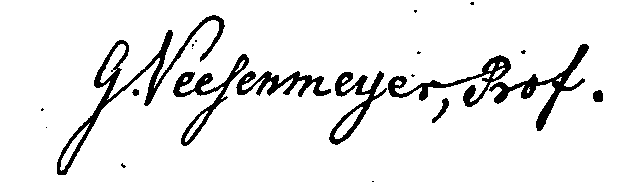
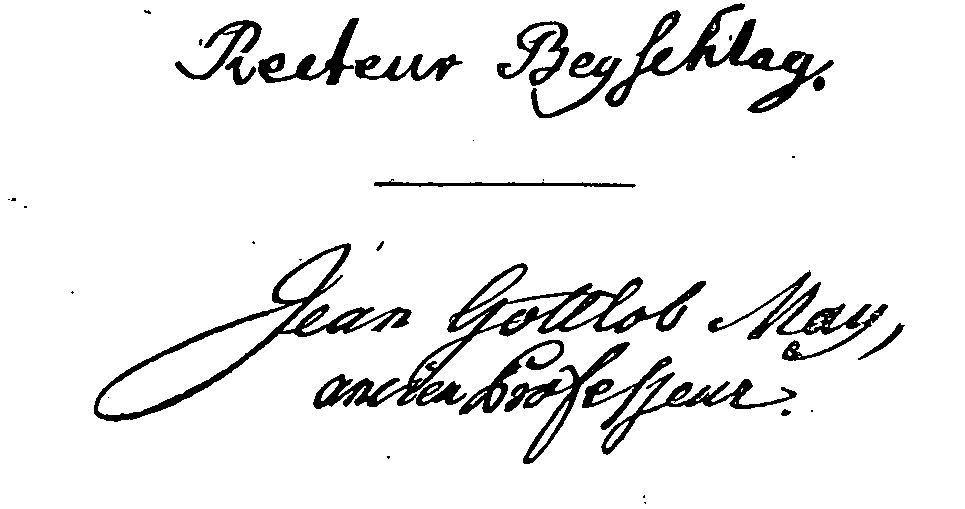
39 [The first Horace, the Cicero Epist. ad Familiares, 1469, the Latin Bible by Frisner and Sensenschmidt, 1475 and the Polish Bible of 1563, (all so warmly and so justly eulogised in the above pages) have been reposing these last ten years in the library of Earl Spencer: and magnificent and matchless as is that library, it contains no FINER volumes than the four preceding. I conclude this detail by subjoining the Autographs of the two BIBLIOGRAPHICAL WORTHIES who have cut such a conspicuous figure in the scene above described. The latter is now NO MORE.]
40 Both the nave and towers appear in Hartmann Schedel's view of Munich, in the Nuremberg Chronicle of 1493: see fol. ccxxvi. The "pepper-box" terminations are, I conceive, of a later date.
41 I take this to be the famous Albert who died in 1500; and who, in Schedel's time, kept lions for his disport--at Munich: "qui sua magnificentia plures nutrit leones" Chron. Norimb. 1493. Ibid.
42 The steeple fell down in the year 1599, and has never been rebuilt.
43 See p. 87 ante.
44 See p. 66 ante.
45 [Sir J. Reynolds criticised these pictures when they were in the Dusseldorf Gallery: but I cannot just now lay my hand upon his remarks.]
46 [It has made, and is yet making, great strides towards the accomplishment of the above-mentioned objects--since the above passage was written.]
47 [With the exception of the first, (although I do not make this exception with confidence) all the above-named gentlemen have CEASED TO EXIST. Mr. Bernhard I believe died before the publication of the preceding edition of this work: and I add, with perfect sincerity, that his decease, and that of M. Adam Bartsch (vide post) were, to me, among the bitterest regrets which I ever experienced in my intercourse with foreign literati.
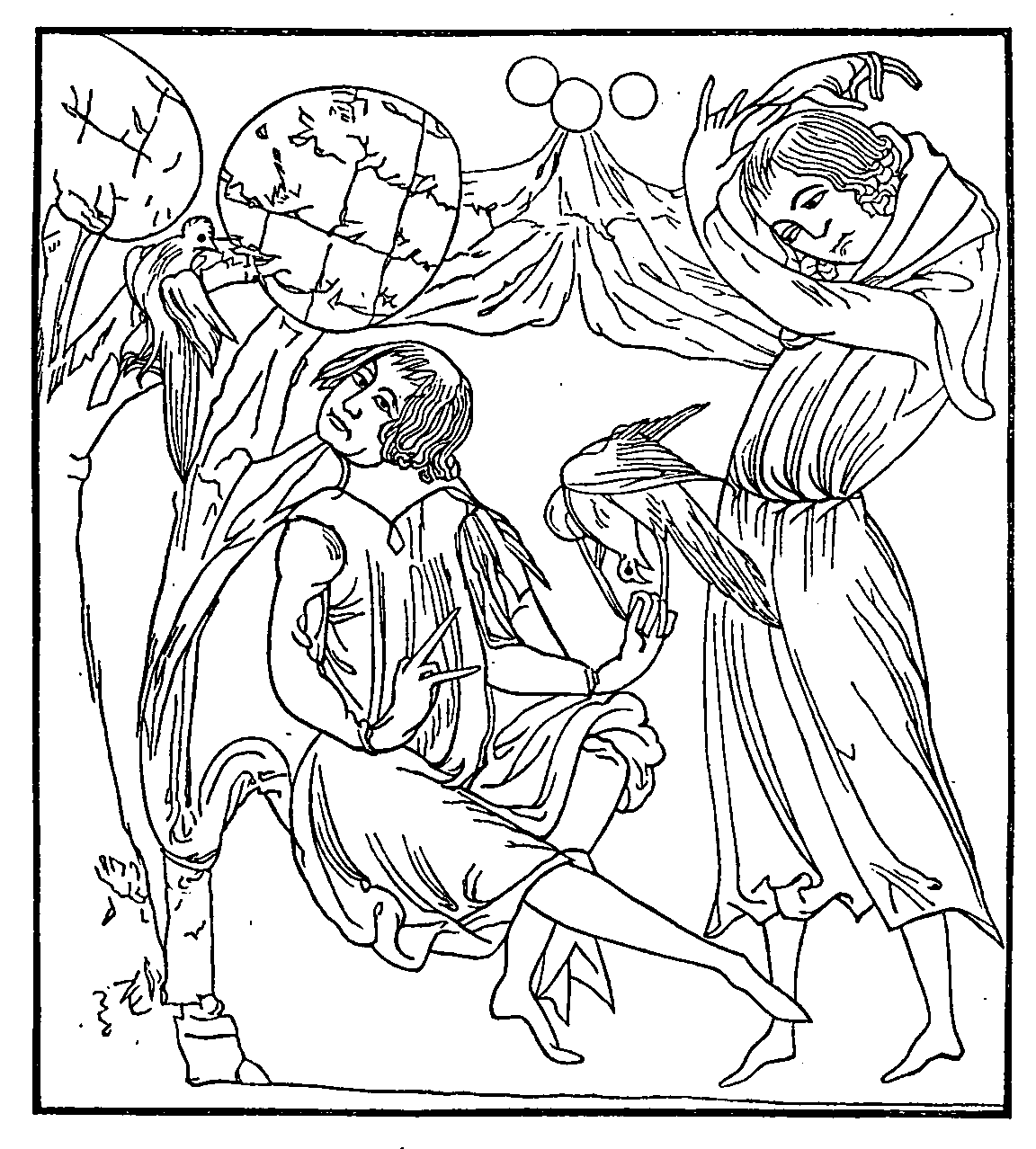
48 The able editor of the Romance of Sir TRISTREAM, ascribed to Thomas of Ercildoune, appears to have been entirely ignorant of the existence of this highly curious and coeval German version. I regret that I am unable to give the reader a complete analysis of the whole.
From this account, I select the following very small portion--of fidelity of version--with a fac-simile of one of the Embellishments.
So all his thoughts were wavering:
Wilen abe vn wilent an-- One while above, and one while down, Er tet wol an im selben schin He truly on himself made shew, Daz der minnende mot That an amorous mind behaves Reht als der vrie fogel tot Even as the bird in the open air, Der durch die friheit dier hat Who, by the liberty he enjoys, Vf daz gelimde twi gestat Slightly sits on the lime-twig down; Als er des limes danne entsebet As soon as he the lime descrys, Vnd er sieh vf ze fluhte hebet And rises up to fly in haste, So chlebet er mit den fossen an. His feet are clinging to the twig.
This simile of the bird seems expressed in the illumination, of which the outline has been faithfully copied by Mr. Lewis:
49 See page 33 ante.
50 It appeared in the year 1808, and was sold for 2l. 12s. 6d. But a blank space was left in the middle--which, in the original, is occupied by a heavy gothic text. The publication of the continuation by Lucas Cranach appeared in 1818.
51 Now in the Collection of Henry Perkins, Esq.
52 See Bibl. Spenceriana, vol. i. p. xv-xxiii. where fac-similes of some of the cuts will be found.
53 Where it is fully described, in vol. ii. p. 188, &c. with fac-similes of the type and ornaments. An entire page of it is given at p. 189.
54 See Bibl. Spenceriana, vol. i. p. xxxi.
55 A copy in the public library at Stuttgart has a ms. memorandum in which the same dominical date is entered. See note, at page 21 ante.
56 It must be mentioned, however, that a fine copy of the German edition of Breydenbach's Travels, of 1486, was given into the bargain.
57 In the Bibl. Spencer, vol. i. p. 38-9--where a fac-simile of the type of this edition is given--the impression is supposed to have been executed in "the year 1468 at latest." The inscription of 1468 in the Strasbourg copy (see vol. ii. p. 404.) should seem at least to justify the caution of this conclusion. But, from the above, we are as justified in assigning to it a date of at least two years earlier.
58 Lord Spencer possesses a copy of St. Austin de Civitate Dei, with the Commentary of Trivetus, printed by Mentelin, which was also illuminated by Bamler in the same year as above--1468. The memorandum to this effect, by Bamler, is given in the Ædes Althorpianæ; vol. ii. p. 20.
59 I will not say positively that the VIRGIL is not there; but I am pretty sure of the absence of the two preceding works. My authority was, of course, the obliging and well informed M. Bernhard.
60 See page 115 ante.
61 The inscription is this: "Anno dni Millesimo cccco lxviijo. Conparatus est iste Katholicon tpe Iohis Hachinger h9 ccclie p tunc imeriti pptti. p. xlviij Aureis R flor9 taxatus p. H xxi faciunt in moneta Vsuali xlvj t d." So that it seems a copy of this work, upon vellum, was worth at the time of its publication, forty-six golden florins.
62 Indicis characterum diversarum manerieru impressioni parataru: Finis. Erhardi Ratdolt Augustensis viri solertissimi: preclaro ingenio & mirifica arte: qua olim Venetijs excelluit celebratissimus. In imperiali nunc vrbe Auguste vindelicorum laudatissime impressioni dedit. Annoq; salutis M.CCCC.LXXXXVI. Cale Aprilis Sidere felici compleuit.
63 An admirably executed fac-simile of the above curious document appears in the work here referred to: vol. ii. p. 131--where the subject of its probable printer is gone into at considerable length.
64 The reader, if he have leisure and inclination, may consult a long note in the Bibliographical Decameron, vol. i. p. 201, respecting the best authorities to be consulted upon the above very splendid and distinguished performance. Camus is included in the list of authorities referred to.
65 Seven years have elapsed since the above was written, but no CLASSED CATALOGUE of any portion of the Public Library of Munich has appeared in this country. Speaking of duplicates, not printed in the fifteenth century, it may be worth observing that they have at Munich not fewer than six copies (double the number of those at Strasbourg;) of the ACTA SANCTORUM; good handsome copies in vellum binding.
[Since the first edition of this Tour was published, several copies of this stupendous, but unfortunately imperfect work, have been imported into England: among which, however, none, to my recollection, have found their way from MUNICH. Indeed, the heavy expense of carriage is almost an interdiction: unless the copies were obtained at very moderate prices.]
66 [See vol. ii. p. 147. Renouard, L'Imprim. des Alde, vol. i. 36- 7. There are however, NOW, I believe, in this country, FIVE copies of this very rare book; of which four are perfect.]
67 The copy in question had, in 1595, been the property of F. Gregorius, prior of the monastery of Sts. Ulric and Afra at Augsbourg: as that possessor's autograph denotes.
68 The principal of these "tempting articles" were a fine first Statius of 1502, Asconius Pedianus, 1522. Cicero de Officiis, 1517, and Leonicerus de Morbo Gallico--with the leaf of errata: wanting in the copy in St. James's Place. But perhaps rarer than either, the Laurentius Maoli and Averrois, each of 1497--intended for presents. But Mr. Stoeger had forgotten these intended presents--and charged them at a good round sum. I considered his word as his bond--and told him that honest Englishmen were always in the habit of so considering the words of honest Germans. I threatened him with the return of the whole cargo, including even the beloved Greek Hours. Mr. Stoeger seemed amazed: hesitated: relented: and adhered to his original position. Had he done otherwise, I should doubtless have erased the epithet "honestissimus," in all the copies of the sale catalogue above alluded to, which might come within my notice, and placed a marginal emendation of "avidissimus."
69 It may be a novel, and perhaps gratifying, sight to the reader to throw his eye over a list (of a few out of the fifty articles) like the following:
Flor. Kreutz.
Liber Moralizat. Biblic. Ulm. 1474. Folio. Fine copy 11
Biblia Vulg. Hist. Ital. Venet. Giunta 1492. Fol 8
Horatius. Venet. 1494. 4to. Fig. lig. incis. 11
Cronica del rey don Iuan. Sevilla. 1563. 4to. 11
Breviarium. Teutonicè. 4to. In MEMBRANIS. A most beautiful and spotless book. It contains only the Pars Hyemalis of the cathedral service. 11
Dictionarium Pauperum. Colon. 1504. 8vo 1
Pars quart. Ind. Orient. Francof. 1601. 5 30
Fabulæ Æsopicæ. Cura Brandt. 1501. Folio. Perhaps a matchless copy; in original binding of wood. Full of cuts 55
Thirteen different opuscula, at one florin each; many very curious and uncommon 13
The Lord's Prayer and Creed--in the German language--printed by "Fricz Crewsner," in 1472: folio: broadside. Perhaps UNIQUE 22
The florin, at the time of my residence at Munich, was about 1s. 9d.
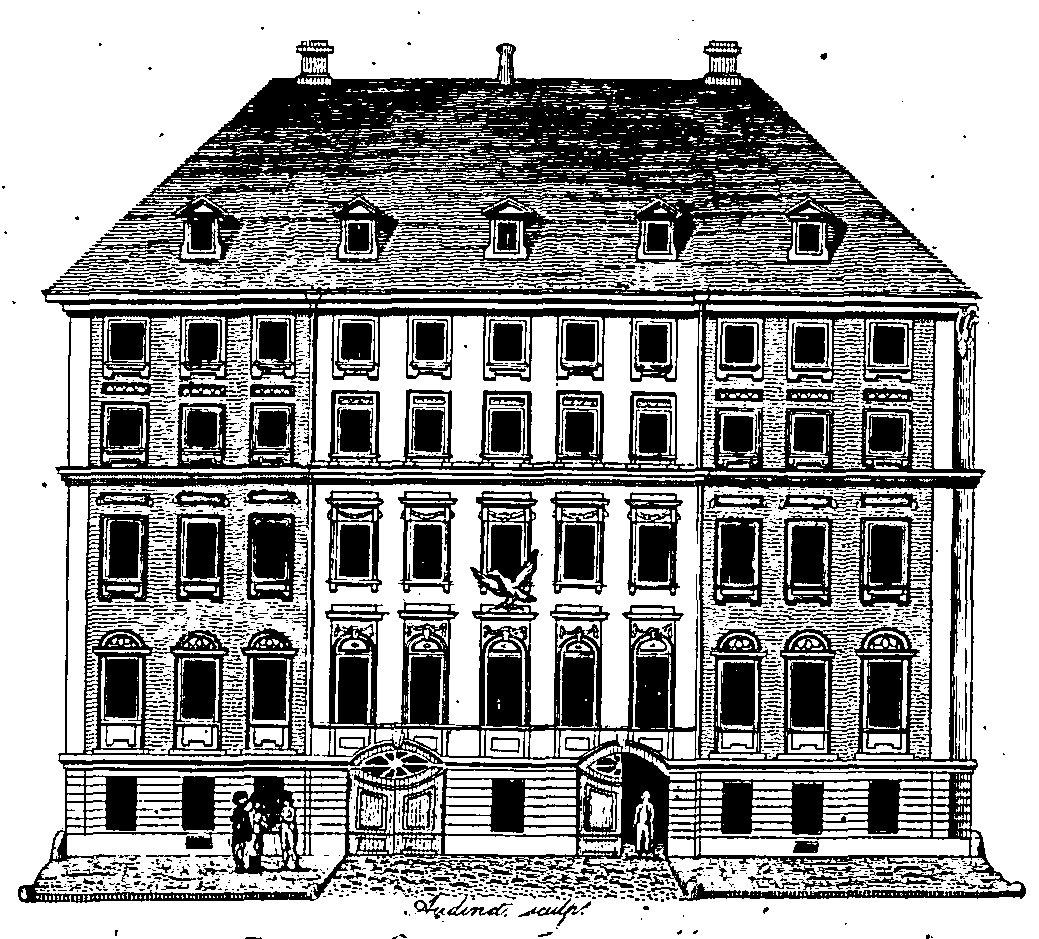
70 [However severely I may have expressed myself in a preceding page (105) of the general condition of this huge Inn, yet I cannot but gaze upon the subjoined view of it with no ordinary sensation of delight when I remember that the three-windowed room, on the first floor, to the right--close to the corner--was the room destined to be graced by the BOOK TREASURES above mentioned. This view may also serve as a general specimen of the frontage of the larger Inns in Bavaria.]
71 [All the book-world has heard mention of THE LINCOLNE NOSEGAY, --a small handful of flowers, of choice hues, and vigorous stems, culled within the precincts of one of the noblest cathedrals in Europe. Neither Covent Garden at home, nor the Marché aux Fleurs at Paris, could boast of such a posey. I learn, however, with something approaching to horror, that the Nosegay in question has been counterfeited. A spurious edition (got up by some unprincipled speculator, and, I must add, bungling hand--for the typographical discrepancy is obvious) is abroad. Roxburghers, look well to your book-armouries! The foe may have crept into them, and exchanged your steel for painted wood.]
72 There is something so hearty and characteristic in the Director's last letter to me, that I hope to be pardoned if I here subjoin a brief extract from it. "M. Schérer vient me quitter, et m'annoncer que votre départ est fixé pour demain. Jamais maladie--auxquelles, heureusement, je suis très rarement exposé--m'est survenu aussi mal-à-propos qu'à cette fois-ci. J'avois compté de jouir encore au moins quelques jours, après mon rétablissement, de votre entretien, et jetter les fondemens d'une amitié collegiale pour la future. La nouvelle, que M. Schérer m'apporte, me désole. J'avois formé le plan de vous accompagner pour voir quelqu'uns de nos Institutions rémarquables, principalement La Lithographie, "Vana Somnia!" Votre résolution de quitter Munich plutôt que je n'avois pensé, détruit mes esperances. N'est-ce-pas possible que vous passiez par Munich à votre retour de Vienne? Utinam! Combien de choses restent, sur lesquelles j'esperais de causer et de traiter avec vous! "I bono alite: pede fausto."

[The author of this Letter is NO MORE!]
73 See the note, p. 157 ante.
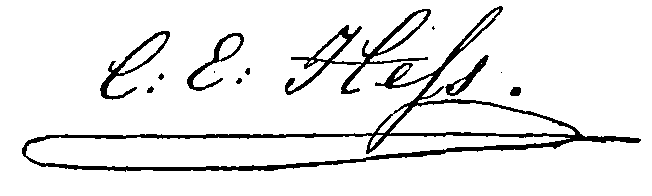
74 This Engraving appears in the Ædes Althorpianæ, vol. i. p. 246. On my return to England, it was necessary to keep up a correspondence with the amiable and intelligent character in question. I make no apology, either to the reader, or to the author of the Epistle, for subjoining a copy of one of these letters--premising, that it relates to fac-similes of several old copper cuts in the Public Library at Munich, as well as to his own engraving of the above-mentioned portrait. There is something throughout the whole of this letter so hearty, and so thoroughly original, that I am persuaded it will be perused with extreme gratification:
Munich, 17 May, 1819.
Dear and Reverend Sir;
I am a good old fellow, and a passable engraver; but a very bad Correspondent. You are a ... and minister of a religion which forgive all faults of mankind; and so I hope that you will still pardon me the retardation of mine answer. I am now 65 years old, and have never had any sickness in mine life, but I have such an averseness against writing, that only the sight of an ink-horn, pen and paper, make me feeling all sort of fevers of the whole medicinal faculty;-- and so I pray that you would forgive me the brevity of mine letters. Following your order, I send you jointly the first proof prints of those plates still (already) finished. The plate of that beautiful head of an English artist, is not yet so far advanced; but in about six weeks you will have it--and during this time, I expect your answer and direction to whom I shall deliver the whole. I wish and hope heartily that the fac-similes and portraits would be correspondent with your expectation.
I hold it for necessary and interesting, to give you a true copy of that old print--"Christ in the lap of God the Father." You'll see that this print is cutten round, and carefully pasted upon another paper on a wooden band of a book: which proves not only a high respect for a precious antiquity, but likewise that this print is much older than the date of 1462--which is written in red ink, over the cutten outlines, of that antique print. You may be entirely assured of the fidelity of both fac-similes. Now I pray you heartily to remember my name to our dear Mr. Lewis, with my friendliest compliments, and told him that the work on Lithography is now finished, and that he shall have it by the first occasion. In expectation of your honorable answer, I assure you of the highest consideration and respect of
Your most obedient humble Servant,
75 [This GRAPHIC WORTHY now ceases to exist. He died in his seventy-first year--leaving behind, the remembrance of virtues to be reverenced and of talents to be imitated.]
76 [Another OBITUARY presses closely upon the preceding--but an Obituary which rends one's heart to dwell upon:--for a kinder, a more diligent, and more faithful Correspondent than was Mr. Nockher, it has never been my good fortune to be engaged with. Almost while writing the above passage, this unfortunate gentleman ... DESTROYED himself:--from embarrassment of circumstances!]
77 See vol. i. p. 199.
78 It is thus entitled: Bibliothecæ Ingolstadiensis Incunabula Typographica, 1787, 4to.: containing four parts. A carefully executed, and indispensably necessary, volume in every bibliographical collection.
79 [I rejoice to add, in this edition of my Tour, that the LOST SHEEP has been FOUND. It had not straggled from the fold when I was at Landshut; but had got penned so snugly in some unfrequented corner, as not to be perceived.]
80 [A vision, however, which AGAIN haunts me!]
81 This copy has since reached England, and has been arrayed in a goodly coat of blue morocco binding. Whether it remain in Cornhill at this precise moment, I cannot take upon me to state; but I can confidently state that there is not a finer copy of the edition in question in his Britannic Majesty's united dominions. [This copy now--1829-- ceases to exist... in Cornhill.]
82 On consulting the Typog. Antiquities, vol. ii. p. 510, I found my conjectures confirmed. The reader will there see the full title of the work--beginning thus: "Eruditissimi Viri Guilelmi Rossei opus elegans, doctum, festiuum, pium, quo pulcherrime retegit, ac refellit, insanas Lutheri calumnias," &c. It is a volume of considerable rarity.
83 The charges were moderate. A bottle of the best red ordinary wine (usually--the best in every respect) was somewhere about 1s. 6d. Our lodgings, two good rooms, including the charge of three wax candles, were about four shillings per day. The bread was excellent, and the cuisine far from despicable.
84 We learn from Pez (Austriacar. Rer. vol. ii. col. 185, taken from the Chronicle of the famous Admont Monastery,) that, in the year 1128, the cathedral and the whole city of Salzburg were destroyed by fire." So, that the antiquity of this, and of other relics, must not be pushed to too remote a period.
85 Before the reader commences the above account of a visit to this monastery, he may as well be informed that the SUBJOINED bird's-eye view of it, together with an abridged history (compiled from Trithemius, and previous chroniclers) appears in the Monasteriologia of Stengelius, published in 1619, folio.
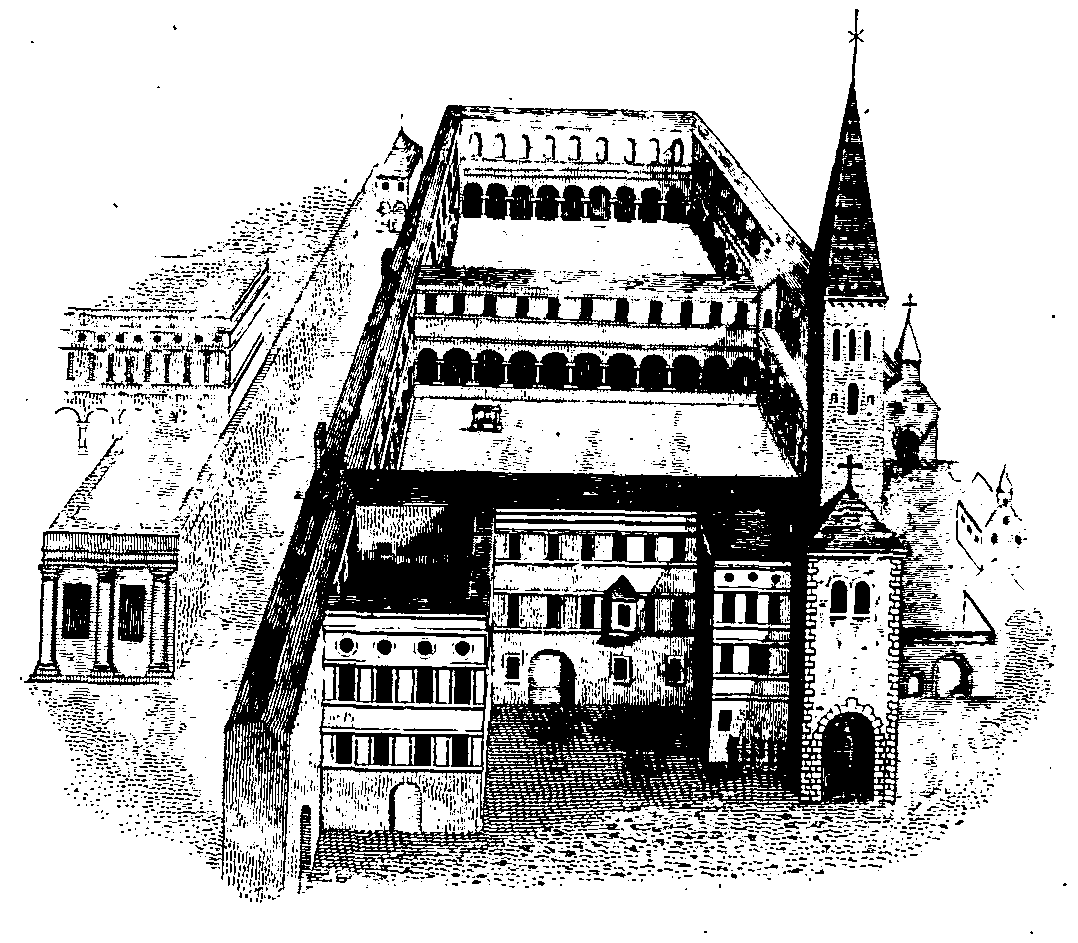
The monastery is there described as--"et vetustate et dignitate nulli è Germaniæ monasteriis secundum." Rudbertus is supposed to have been its founder:--"repertis edificiis basilicam in honore SANCTI PETRI construxit:" Chronicon Norimberg. fol. cliii.; edit. 1493. But this took place towards the end of the sixth century. From Godfred's Chronicon Gotvvicense, 1732, folio, pt. i. pp. 37, 39, 52--the library of this Monastery, there called "antiquissima," seems to have had some very ancient and valuable MSS. In Stengelius's time, (1620) the monastery appears to have been in a very flourishing condition.
86 As it is just possible the reader may not have a very distinct recollection of this worthy old gentleman, and ambulatory abbot--it may be acceptable to him to know, that, in the Thanatologia of Budæus (incorporated in the Tres Selecti Scriptores Rerum Germanicarum, 1707, folio, p. 27, &c.) the said Neander is described as a native of Sorau, in Bohemia, and as dying in his 70th year, A.D. 1595, having been forty-five years Principal of the monastery of St. Ildefonso. A list of his works, and a laudatory Greek epigram, by Budæus, "UPON HIS EFFIGY," follow.
87 For the sake of juxta-position I here lay before the reader a short history of the issue, or progress of the books in question to their present receptacle, in St. James's Place. A few days after reaching Vienna, I received the following "pithy and pleasant" epistle from the worthy librarian, "Mon très-revérend Pasteur. En esperant que vous êtes arrivé à Vienne, à bon port, j'ai l'honneur de declarer à vous, que le prix fixé des livres, que vous avez choisi, et dont la table est ajoutée, est 40 louis d'or, ou 440 florins. Agréez l'assurance, &c.
I wrote to my worthy friend Mr. Nockher at Munich to settle this subject immediately; who informed me, in reply, that the good monks would not part with a single volume till they had received "the money upon the nail,"--"l'argent comptant." That dexterous negotiator quickly supplied them with the same; received the case of books; and sent them down the Rhine to Holland, from thence to England: where they arrived in safe and perfect condition. They are all described in the second volume of the Ædes Athorpianæ; together with a beautiful fac-simile of an illuminated head, or portrait, of Gaietanus de Tienis, who published a most elegantly printed work upon Aristotle's four books of Meteors, printed by Maufer, in 1476, folio; and of which the copy in the Salzburg library was adorned by the head (just mentioned) of the Editor. Æd. Althorp. vol. ii. p. 134. Among the books purchased, were two exquisite copies, filled with wood cuts, relating to the Æsopian Fables: a copy of one of which, entitled Æsopus Moralisatus, was, I think, sold at the sale of the Duke of Marlborough's books, in 1819, for somewhere about 13l.
88 In Hartmann Schedel's time, Salzburg--which was then considered as the CAPITAL OF BAVARIA--"was surrounded by great walls, and was adorned by many beautiful buildings of temples and monasteries." A view of Salzburg, which was formerly called JUVAVIA, is subjoined in the Nuremberg Chronicle, fol. CLIII. edit. 1493. Consult also the Chronicon Gotvvicense, 1732, folio, pt. ii. p. 760-- for some particulars respecting the town taking its name from the river Juvavia or Igonta. Salzburg was an Archbishopric founded by Charlemagne: see the Script. Rer. German. edited by Nidanus et Struvius, 1726 folio, vol. i. p. 525.
89 On the morning following my arrival at Salzburg, I purchased a card, and small chart of the adjacent country and mountains. Of the latter, the Gross Klokner, Klein Klokner, are each about 12000 feet above the level of the sea; The Weisbachhorn is about 11000 feet of similar altitude; Der Hohe Narr about the same height; and the Hohe Warte about 10,000; while the Ankogl and Herzog Ernst, are 9000 each. The lowest is the Gaisberg of 4000 feet; but there is a regular gradation in height, from the latter, to the Gross Klokner, including about 25 mountains.
[Illustration]
90 Vol. ii. p. 352-3.
91 See p. 217 ante.
92 It should seem, from the pages of PEZ and NIDANUS, that Charlemagne was either the founder, or the patron, or endower, of almost every monastery in Germany. Stengelius, however, gives a a very romantic origin to the foundation of Chremsminster. "The eldest son of Tassilo, a Duke or Elector of Bavaria, went out a hunting in the winter; when, having been separated from his companions, in a large wood, he met a wild boar of an enormous size, near a fountain and pool of water. Notwithstanding the fearful odds between them, Tassilo gallantly received the animal upon the point of his hunting spear, and dispatched him with a tremendous wound: not however without a fatal result to himself. Rage, agony, and over exertion... proved fatal to the conqueror: and when, excited by the barking of the dogs, his father and the troop of huntsmen came up to see what it might be, they witnessed the spectacle of the boar and the young Tassilo lying DEAD by the side of each other. The father built the MONASTERY of CHREMSMINSTER upon the fatal spot--to the memory of his beloved but unfortunate son. He endowed it with large possessions, and his endowments were confirmed by Pope Adrian and the Emperor Charlemagne-- in the year 777. The history of the monastery is lost in darkness, till the year 1046, when Engelbert, Bishop of Passau, consecrated it anew; and in 1165, Diepold, another Bishop of Passau, added greatly to its possessions; but he was, in other respects, as well as Manegold in 1206, a very violent and mischievous character. Bishop Ulric, in 1216, was a great benefactor to it; but I do not perceive when the present building was erected: although it is possible there may be portions of it as old as the thirteenth century. See Pez: Script. Rer. Austriac., vol. i. col. 1305, &c.: vol. ii. col. 67, &c. At the time of publishing the Monasteriologia of Stengelius, 1638, (where there is a bird's-eye view of the monastery, as it now generally appears) Wolffradt (or Wolfardt) was the Abbot--who, in the author's opinion, "had no superior among his predecessors." I go a great way in thinking with Stengelius; for this worthy Abbot built the Monks a "good supper-room, two dormitories, a sort of hospital for the sick, and a LIBRARY, with an abundant stock of new books. Also a sacristy, furnished with most costly robes, &c." Monasteriologia; sign. A. It was doubtless the BIBLIOTHECA WOLFRADTIANA in which I tarried--as above described--with equal pleasure and profit.
93 See vol. ii. p. 199.
94 This I presume to be the "spurious" Birmingham edition, which is noticed by Steevens in the Edit. Shakspeare, 1813. 8vo. vol. ii. p. 151.
95 They were both secured. One copy is now in the ALTHORP LIBRARY, and the other in that of Mr. Heber.
96 On the very night of my arrival at Lintz, late as it was, I wrote a letter to the Abbot, or head of the monastery, addressed thus--as the Professor had written it down: "Ad Reverendissimum Dominum Anselmum Mayerhoffer inclyti Monasterii Cremifanensis Abbatem vigilantissimum Cremifanum." This was enclosed in a letter to the Professor himself with the following direction: "Ad Rev. Dm. Udalricum Hartenschneider Professum Monasterij Cremifanensis et Historiæ ibidem Professorem publicum. Cremifanum:" the Professor having put into my hands the following written memorandum: "Pro commutandis--quos designasti in Bibliotheca nostra, libris--primo Abbatem adire, aut litteris saltem interrogare necesse est: quas, si tibi placuerit, ad me dirigere poteris."

This he wrote with extreme rapidity. In my letter, I repeated the offer about the Monasticon; with the addition of about a dozen napoleons for the early printed books above mentioned; requesting to have an answer, poste restante, at Vienna. No answer has since reached me. The Abbot should seem to have preferred Statius to Dugdale. [But his Statius NOW has declined wofully in pecuniary worth: while the Dugdale, in its newly edited form, has risen threefold.]
97 St. FLORIAN was a soldier and sufferer in the time of the Emperors Diocletian and Maximinian. He perished in the tenth and last persecution of the Christian Church by the Romans. The judge, who condemned him to death, was Aquilinus. After being importuned to renounce the Christian religion, and to embrace the Pagan creed, as the only condition of his being rescued from an immediate and cruel death, St. Florian firmly resisted all entreaties; and shewed a calmness, and even joyfulness of spirits, in proportion to the stripes inflicted upon him previous to execution. He was condemned to be thrown into the river, from a bridge, with a stone fastened round his neck. The soldiers at first hesitated about carrying the judgment of Aquilinus into execution. A pause of an hour ensued: which was employed by St. Florian in prayer and ejaculation! A furious young man then rushed forward, and precipitated the martyr into the river: "Fluvius autem suscipiens martyrem Christi, expavit, et elevatis undis suis, in quodam eminentiori loco in saxo corpus ejus deposuit. Tunc annuente favore divino, adveniens aquila, expansis alis suis in modum crucis, eum protegebat." Acta Sanctorum; Mens. Maii, vol. i. p. 463. St. Florian is a popular saint both in Bavaria and Austria. He is usually represented in armour, pouring water from a bucket to extinguish a house, or a city, in flames, which is represented below. Raderus, in his Bavaria Sacra, vol. i. p. 8, is very particular about this monastery, and gives a list of the pictures above noticed, on the authority of Sebastianus ab Adelzhausen, the head of the monastery at that time; namely in 1615. He also adorns his pages with a copper cut of the martyr about to be precipitated into the river, from the bank--with his hands tied behind him, without any stone about his neck. But the painting, as well as the text of the Acta Sanctorum, describes the precipitation as from a bridge. The form of the Invocation to the Saint is, "O MARTYR and SAINT, FLORIAN, keep us, we beseech thee, by night and by day, from all harm by FIRE, or from other casualties of this life."
98 "Nostris vero temporibus Reverendissimi Præpositi studio augustum sanc templum raro marmore affatim emicans, paucisque inuidens assurexit." This is the language of the Germania Austriaca, seu Topographia Omnium Germaniæ Provinciarum, 1701, folio, p. 16: when speaking of THE MONASTERY of ST. FLORIAN.
99 See p. 78, ante.
100 It may be only sufficient to carry it as far back as the twelfth century. What precedes that period is, as usual, obscure and unsatisfactory. The monastery was originally of the Benedictin order; but it was changed to the Augustine order by Engelbert. After this latter, Altman reformed and put it upon a most respectable footing--in 1080. He was, however, a severe disciplinarian. Perhaps the crypt mentioned by M. Klein might be of the latter end of the XIIth century; but no visible portion of the superincumbent building can be older than the XVIth century.
101 The history of this monastery is sufficiently fertile in marvellous events; but my business is to be equally brief and sober in the account of it. In the Scriptores Rerum Austriacarum of Pez, vol. i. col. 162-309, there is a chronicle of the monastery, from the year of its foundation to 1564, begun to be written by an anonymous author in 1132, and continued to the latter period by other coeval writers--all monks of the monastery. It is printed by Pez for the first time--and he calls it "an ancient and genuine chronicle." The word Mölk, or Mölck,--or, as it appears in the first map in the Germania Austriaca, seu Topographia Omnium Germaniæ Provinciarum, 1701, fol. Melck--was formerly written "Medilicense, Medlicense, Medlicum, Medlich, and Medelick, or Mellicense." This anonymous chronicle, which concludes at col. 290, is followed by "a short chtonicle of Conrad de Wizenberg," and "an anonymous history of the Foundation of the Monastery," compared with six other MSS. of the same kind in the library at Mölk. The whole is concluded by "an ancient Necrology of the Monastery," commenced in the XIIth century, from a vellum MS. of the same date.
In the Monasteriologia of Stengelius, we have a list of the Heads or Primates of Mölk, beginning with Sigiboldus, in 1089, (who was the first that succeeded Leopold, the founder) down to Valentinus, in 1638; who was living when the author published his work. There is also a copper-plate print of a bird's eye view of the monastery, in its ancient state, previously to the restoration of it, in its present form, by DIETMAYR.
102 [The late Duke.]
103 I do not however find it in the Notitia Literaria prefixed to the edition of Horace, published by Mitscherlich in 1800: see vol. i. p. xxvi. where he notices the MSS. of the poet which are deposited in the libraries of Germany.
104 It was not till my arrival at Manheim, on my return to Paris, that I received the "definitive reply" of the worthy Sub-Principal--which was after the following manner. "Monsieur--La lettre du 21 Septembre, que vous m'avez faite l'honneur de m'écrire, je ne l'ai reçue que depuis peu, c'est-à-dire, depuis le retour de mon voyage. Les scrupules que vous faites touchant l'échange des livres, ont été levés par vous-même dans l'instant que vous en avez faites la proposition. Mais, malheureusement, la lettre qui devait apporter la confirmation du Prélat, n'a apportée que la triste nouvelle de sa mort. Vous sentez bien, que dès ce moment il ne sauroit plus être question de rien. Je ne doute pas, que quoique aucun livre ancien ne soit jusqu'à ce moment sorti de la Bibliothèque du Couvent, le Prélat n'eut fait une exception honorable en égard a l'illustre personnage auquel ces livres ont été destines et à la collection unique d'un art, a fait naitre toutes les bibliothèques, &c. J'ai l'honneur, &c. votre trés humble et très obeisant serviteur,
105 In an octavo volume published by a Dr. Cadet, who was a surgeon in Bonaparte's army in the campaign in Austria, in 1809, and who entitles his work--Voyage en Autriche, en Moravie, et en Bavière-- published at Paris in 1818--we are favoured with a slight but spirited account of the monastery of Mölk--of the magnificence of its structure, and of the views seen from thence: but, above all, of the PRODUCE OF ITS CELLARS. The French Generals were lodged there, in their route to Vienna; and the Doctor, after telling us of the extent of the vaults, and that a carriage might be turned with ease in some of them, adds, "in order to have an idea of the abundance which reigns there, it may be sufficient only to observe, that, for four successive days, during the march of our troops through Mölk, towards Vienna, there were delivered to them not less than from 50 to 60,000 pints of wine per day--and yet scarcely one half of the stock was exhausted! The monastery, however, only contains twelve Réligieux. The interior of the church is covered with such a profusion of gilt and rich ornaments, that when the sun shines full upon it, it is difficult to view it without being dazzled." Page 79.
The old monastery of Mölk successfully stood a siege of three months, against the Hungarians, in the year 1619. See Germ. Austriaca, &c. p. 18.
106 [The Abbé Strattman SURVIVED the above interview only about five years. I hope and trust that the worthy Vice Principal is as well NOW, as he was about three years ago, when my excellent friend Mr. Lodge, the Librarian of the University of Cambridge, read to him an off-hand German version of the whole of this account of my visit to his Monastery.]
107 This history has come down to us from well authenticated materials; however, in the course of its transmission, it may have been partially coloured with fables and absurdities. The Founder of the Monastery was ALTMANN, Bishop of Passau; who died in the year 1091, about twenty years after the foundation of the building. The two ancient biographies of the Founder, each by a Monk or Principal of the monastery, are introduced into the collection of Austrian historians by Pez; vol. i. col. 112-162. Stengelius has a bird's eye view of the monastery as it appeared in 1638, and before the principal suite of apartments was built. But it is yet in an unfinished state; as the view of it from the copper-plate engraving, at page 248 ante, represents it with the intended additions and improvements. These latter, in all probability, will never be carried into effect. This monastery enjoyed, of old, great privileges and revenues. It had twenty-two parish churches--four towns--several villages, &c. subject to its ecclesiastical jurisdiction; and these parishes, together with the monastery itself, were not under the visitation of the Diocesan (of Passau) but of the Pope himself. Stengelius (Monasteriologia, sign. C) speaks of the magnificent views seen from the summit of the monastery, on a clear day; observing, however, (even in his time) that it was without springs or wells, and that it received the rain water in leaden cisterns. "Cæterùm (adds he) am[oen]issimum et plané aspectu jucundissimum habet situm." Towards the middle of the seventeenth century, this monastery appears to have taken the noble form under which it is at present beheld. It has not however escaped from more than one severe visitation by the Turks.
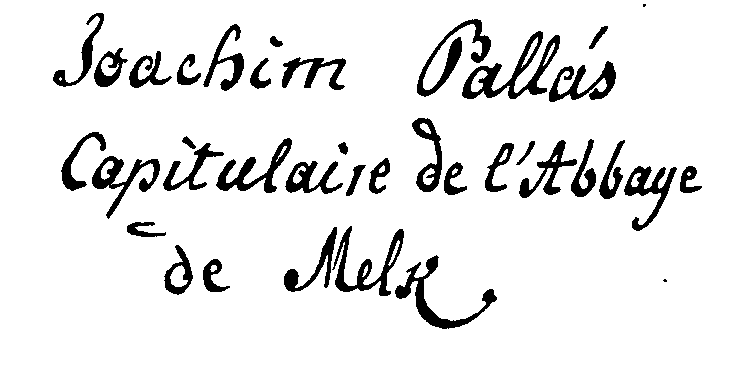
108 On my arrival in England, I was of course equally anxious and happy to place the CHRONICON GÖTWICENSE in the library at Althorp. But I have not, in the text above, done full justice to the liberality of the present Abbot of the monastery. He gave me, in addition, a copy-- of perhaps a still scarcer work--entitled "Notitia Austriæ Antiquæ et Mediæ seu tam Norici Veteris quam Pagi et Marchæ, &c." by MAGNUS KLEIN, Abbot of the monastery, and of which the first volume only was published "typis Monasterii Tegernseensis," in 1781, 4to. This appears to be a very learned and curious work. And here ... let me be allowed for the sake of all lovers of autographs of good and great men--to close this note with a fac-simile of the hand writing (in the "dono dedit"--as above mentioned) of the amiable and erudite donor of these acceptable volumes. It is faithfully thus:--the original scription will only, I trust, perish with the book:

109 [All this is profound matter, or secret history--(such as my friend Mr. D'Israeli dearly loves) for future writers to comment upon.]
110 [Mons. Bartsch did NOT LIVE to peruse this humble record of his worth. More of him in a subsequent note.]
111 [M. Payne now CEASES TO EXIST.]
112 My excellent friend M.A. DE BARTSCH has favoured me with the following particulars relating to the Imperial Library. The building was begun in 1723, and finished in 1735, by Joseph Emanuel, Baron de Fischer, Architect of the Court: the same who built the beautiful church of St. Charles Borromeo, in the suburbs. The Library is 246 German feet in length, by 62 in width: the oval dome, running at right angles, and forming something like transepts, is 93 feet long, and 93 feet high, by 57 wide. The fresco-paintings, with which the ceiling of the dome in particular is profusely covered, were executed by Daniel Gran. The number of the books is supposed to amount to 300,000 volumes: of which 8000 were printed in the XVth. century, and 750 are atlas folios filled with engravings. These 750 volumes contain about 180,000 prints; of which the pecuniary value, according to the computation of the day, cannot be less than 3,300,000 "florins argent de convention"--according to a valuation (says M. Bartsch) which I made last year. This may amount to £300,000. of our money. I apprehend there is nothing in Europe to be put in competition with such a collection.
113 The reader may not be displeased to consult, for one moment, the Bibliog. Decameron; vol. i. pp. xliii. iv.
114 [A sad tale is connected with the procuring of a copy, or fac-simile, of the initial letter in question. I was most anxious to possess a coloured fac-simile of it; and had authorised M. Bartsch to obtain it at almost any price. He stipulated (I think with M. Fendi) to obtain it for £10. sterling; and the fac-simile was executed in all respects worthy of the reputation of the artist, and to afford M. Bartsch the most unqualified satisfaction. It was dispatched to me by permission of the Ambassador, in the Messenger's bag of dispatches:--but it NEVER reached me. Meanwhile my worthy friend M. Bartsch became impatient and almost angry at the delay; and the artist naturally wondered at the tardiness of payment. Something like suspicion had began to take possession of my friend's mind-- when the fact was disclosed to him ... and his sorrow and vexation were unbounded. The money was duly remitted and received; but "the valuable consideration" was never enjoyed by the too enthusiastic traveller. This beautiful copy has doubtless perished from accident.]
115 Vol. ii. p. 458.
116 Tasso, in fact, retouched and almost remodelled his poem, under the title of Jerusalem Conquered, and published it under that of Jerusalem Delivered. See upon these alterations and corrections, Brunet, Manuel du Libraire, vol. iii. p. 298. edit. 1814; Haym Bibl. Ital. vol. ii. p. 28. edit. 1808; and particularly Ginguené Hist. Lit. d'Italie, vol. v. p. 504.
117 See p. 139, ante.
118 Lord Spencer has now obtained a copy of it--as may be seen in Ædes Althorpianæ, vol. ii. pp. 39-40, where a facsimile of the type is given.
119 See pages 98, 103, 228, 239, ante. His Lordship's first copy of the POLISH PROTESTANT BIBLE had been obtained from three imperfect copies at VIENNA; for which I have understood that nearly a hundred guineas were paid. The Augsbourg copy now supplies the place of the previous one; which latter, I learn, is in the Bodleian library, at Oxford.
120 A particular account of this edition will be found in the Bibl. Spencer. vol. iv. page 522.
121 See the Bibl. Spencer.; vol. i. page 135-144.
122 It is singular enough that the Curators of this Library, some twenty years ago, threw out PRINCE EUGENE'S copy of the above edition, as a duplicate--which happened to be somewhat larger and finer. This latter copy, bound in red morocco, with the arms of the Prince on the sides, now graces the shelves of Lord Spencer's Library. See Bibl. Spenceriana, vol. i. p. 305, 7.
123 See vol. ii. p. 120.
124 See vol. ii. p: 120.
125 Including LEXICOGRAPHY.
126 A copy of this edition (printed in all probability by Fyner of Eislingen) was sold at the sale of Mr. Hibbert's library for £8. 12s.
127 [Of which, specimens appear in the Ædes Althorpianæ, vol. ii. p. 273, &c. from the copy in Lord Spencer's collection--a copy, which may be pronounced to be the FINEST KNOWN copy in the world!]
128 Bibl. Spenceriana; vol. iv. p. 121.
129 Vol. ii. p. 191.
130 This book is fully described, with numerous fac-similes of the wood- cuts, in the Ædes' Althorpianæ, vol. ii. p. 204-213.
131 Since the above was written, Lord Spencer has obtained a very fine and perfect copy of it, through Messrs. Payne and Foss: which copy will be found fully described, with a fac-simile of a supposed whole- length portrait of MARCO POLO, in the Ædes Althorpianæ, vol. ii. p. 176.
132 I think I remember to have seen, at Messrs. Payne and Foss's, the finest copy of this book in England. It was upon vellum, in the original binding, and measured fourteen inches three quarters by nine and a half. Unluckily, it wanted the whole of the table at the end. See the Bibliog. Decameron, vol. i. p. 202. [Recently, my neighbour and especial good friend Sir F. Freeling, Bart. has fortunately come into the possession of a most beautifully fair and perfect copy of this resplendent volume.]
133 While upon the subject of this book, it may not be immaterial to add, that I saw the ORIGINAL PAINTINGS from which the large wood blocks were taken for the well known work entitled "the Triumphs of the Emperor Maximilian" in large folio. These paintings are in water colours, upon rolls of vellum, very fresh--and rather gaudily executed. They do not convey any high notion of art, and I own that I greatly prefer the blocks (of which I saw several) to the original paintings. These were the blocks which our friend Mr. Douce entreated Mr. Edwards to examine when he came to Vienna, and with these he printed the well-known edition of the Triumphs, of the date of 1794.
134 In Hartman Schedel's time, these suburbs seem to have been equally distinguished. "Habet (says he, speaking of Vienna) SUBURBIA MAXIMA et AMBICIOSA." Chron. Norimb. 1493. fol. xcviii. rev.
135 Schedel's general description of the city of Vienna, which is equally brief and spirited, may deserve to be quoted. "VIENNA autem urbs magnifica ambitu murorum cingitur duorum millium passuum: habet fossa et vallo cincta: urbs autem fossatum magnum habet: undique aggerem prealtum: menia deinde spissa et sublimia frequentesque turres; et propugnacula ad bellum prompta. Ædes civium amplae et ornatae: structura solida et firma, altæ domorum facies magnificaeque visuntur. Unum id dedecori est, quod tecta plerumque ligna contegunt pauca lateres. Cetera edificia muro lapideo consistunt. Pictæ domus, et interius et exterius splendent. Ingressus cuiusque domum in ædes te principis venisse putabis." Ibid. This is not an exaggerated description. A little below, Schedel says "there is a monastery, called St. Jerome, (much after the fashion of our Magdalen) in which reformed Prostitutes are kept; and where, day and night, they sing hymns in the Teutonic dialect. If any of them are found relapsing into their former sinful ways, they are thrown headlong into the Danube." "But (adds he) they lead, on the contrary, a chaste and holy life."
136 I suspect that the houses opposite the Palace are of comparatively recent construction. In Pfeffel's Viva et Accurata Delineatio of the palaces and public buildings of Vienna, 1725 (oblong folio,) the palace faces a wide place or square. Eighteen sculptured human figures, apparently of the size of life, there grace the topmost ballustrade in the copper-plate view of this truly magnificent residence.
137 [Recently however the number of Restaurateurs has become considerable.]
138 In Hartmann Schedel's time, there appears to have been a very considerable traffic in wine at Vienna: "It is incredible (says he) what a brisk trade is stirring in the article of wine,139 in this city. Twelve hundred horses are daily employed for the purposes of draught--either for the wine drank at Vienna, or sent up the Danube-- against the stream--with amazing labour and difficulty. It is said that the wine cellars are frequently as deep below the earth, as the houses are above it." Schedel goes on to describe the general appearance of the streets, and the neatness of the interiors, of the houses: adding, "that the windows are generally filled with stained glass, having iron-gratings without, where numerous birds sing in cages. The winter (remarks he) sets in here very severely." Chron. Norimb. 1493, fol. xcix.
139 The vintage about Vienna should seem to have been equally abundant a century after the above was written. In the year 1590, when a severe shock of earthquake threatened destruction to the tower of the Cathedral--and it was absolutely necessary to set about immediate repairs--the liquid which was applied to make the most astringent mortar, was WINE: "l'on se servit de vin, qui fut alors en abondance, pour faire le plâtre de cette batise." Denkmahle der Baukunst und Bildneren des Mittelalters in dem Oesterreichischen Kaiserthume. Germ. Fr. Part iii. p. 36. 1817-20.
140 There is a good sized (folded) view of the church, or rather chiefly of the south front of the spire, in the "Vera et Accurata Delineatio Omnium Templorum et Cænobiorum" of Vienna, published by Pfeffel in the year 1724, oblong folio.
141 This head has been published as the first plate in the third livraison of the ECCLESIASTICAL ANTIQUITIES of Vienna--accompanied by French and German letter-press. I have no hesitation in saying that, without the least national bias or individual partiality, the performance of Mr. Lewis--although much smaller, is by far the most faithful; nor is the engraving less superior, than the drawing, to the production of the Vienna artist. This latter is indeed faithless in design and coarse in execution. Beneath the head, in the original sculpture, and in the latter plate, we read the inscription M.A.P. 1313. It is no doubt an interesting specimen of sculpture of the period.
142 Vol. ii. p. 312-313.
143 There is a large print of it (which I saw at Vienna) in the line manner, but very indifferently executed. But of the last, detached group, above described, there is a very fine print in the line manner.
144 See p. 245 ante.
145 As in that of the Feast of Venus in the island of Cythera: about eleven feet by seven. There is also another, of himself, in the Garden of Love--with his two wives--in the peculiarly powerful and voluptuous style of his pencil. The picture is about four feet long. His portrait of one of his wives, of the size of life, habited only in an ermine cloak at the back (of which the print is well known) is an extraordinary production ... as to colour and effect.
146 I am not sure whether any publication, connected with this extraordinary collection, has appeared since Chrétien de Mechel's Catalogue des Tableaux de la Galerie Impériale et Royale de Vienne; 1784, 8vo.: which contains, at the end, four folded copper-plates of the front elevations and ground plans of the Great and Little Belvederes. He divides his work into the Venetian, Roman, Florentine, Bolognese, and Ancient and Modern Flemish Schools: according to the different chambers or apartments. This catalogue is a mere straight-forward performance; presenting a formal description of the pictures, as to size and subject, but rarely indulging in warmth of commendation, and never in curious and learned research. The preface, from which I have gleaned the particulars of the History of the Collection, is sufficiently interesting. My friend M. Bartsch, if leisure and encouragement were afforded him, might produce a magnificent and instructive work--devoted to this very extraordinary collection. (Upon whom, NOW, shall this task devolve?!)
147 See the OPPOSITE PLATE.
148 The truth is, not only fac-similes of these illuminations, but of the initial L, so warmly mentioned at page 292, were executed by M. Fendi, under the direction of my friend M. Bartsch, and dispatched to me from Vienna in the month of June 1820--but were lost on the road.
149 Lord Spencer has recently obtained a copy of this exquisitely printed book from the M'Carthy collection. See the Ædes Althorpianæ; vol. ii. p. 192.
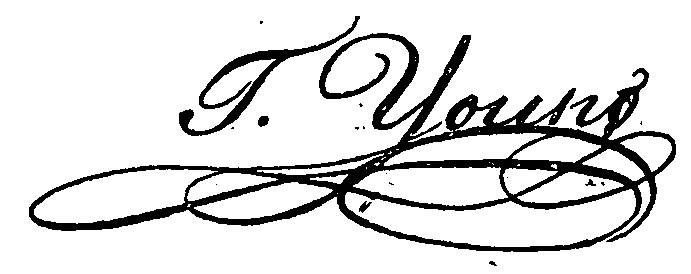
150 [I annex, with no common gratification, a fac-simile of the Autograph of this most worthy man,]
151 He has (now) been dead several years.
152 ECKHEL'S work upon these gems, in 1788, folio, is well known. The apotheosis of Augustus, in this collection, is considered as an unrivalled specimen of art, upon sardonyx. I regretted much not to have seen these gems, but the floor of the room in which they are preserved was taken up, and the keeper from home.
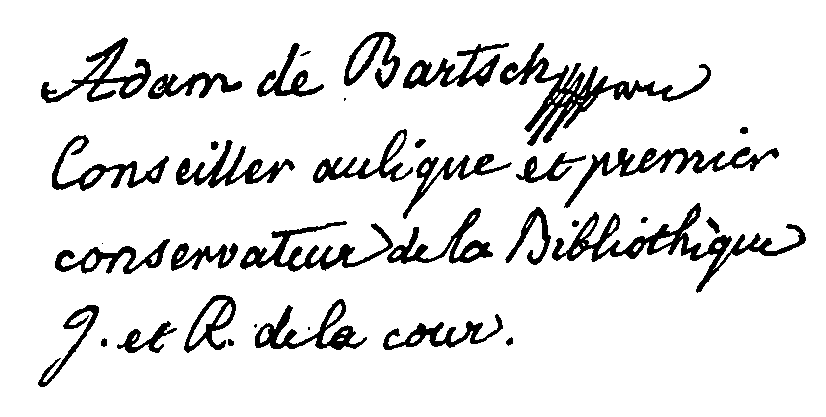
153 It will be only necessary to mention--for the establishment of this fact--the ENGRAVED WORKS alone of M. Bartsch, from masters of every period, and of every school, amounting to 505 in number: an almost incredible effort, when we consider that their author has scarcely yet passed his grand climacteric. His Peintre Graveur is a literary performance, in the graphic department, of really solid merit and utility. The record of the achievements of M. Bartsch has been perfected by the most affectionate and grateful of all hands--those of his son, Frederic de Bartsch--in an octavo volume, which bears the following title, and which has the portrait (but not a striking resemblance) of the father prefixed:--"Catalogue des Estampes de J. ADAM de BARTSCH, Chevalier de l'Ordre de Léopold, Conseiller aulique et Premier Garde de la Bibl. Imp. et Roy. de la Cour, Membre de l'Academie des Beaux Arts de Vienne." 1818. 8vo. pp. 165. There is a modest and sensible preface by the son--in which we are informed that the catalogue was not originally compiled for the purpose of making it public.
The following is a fac-simile of the Autograph of this celebrated graphical Critic and Artist.
154 The MONASTERY of CLOSTERNEUBURG, or Nevenburg, or Nuenburg, or Newburg, or Neunburg--is supposed to have been built by Leopold the Pious in the year 1114. It was of the order of St. Augustin. They possess (at the monastery, it should seem) a very valuable chronicle, of the XIIth century, upon vellum--devoted to the history of the establishment; but unluckily defective at the beginning and end. It is supposed to have been written by the head of the monastery, for the time being. It is continued by a contemporaneous hand, down to the middle of the fourteenth century. They preserve also, at Closterneuburg, a Necrology--of five hundred years--down to the year 1721. "Inter cæteros præstantes veteres codices manuscriptos, quos INSIGNIS BIBLIOTHECA CLAUSTRO-NEOBURGENSIS servat, est pervetus inclytæ ejusdem canoniæ Necrologium, ante annos quingentos in membranis elegantissimè manu exaratum, et a posteriorum temporum auctoribus continuatum." Script. Rer. Austriacar. Cura Pez. 1721. vol. 1. col. 435, 494.
155 The librarian, MAXIMILIAN FISCHER, informed me the quarto copies were rare, for that only 400 were printed. The octavo copies are not so, but they do not contain all the marginal references which are in the quarto impressions.
156 In fact, I wrote a letter to the librarian, the day after my visit, proposing to give 2000 florins in specie for the volumes above described. My request was answered by the following polite, and certainly most discreet and commendable reply: "D....Domine! Litteris a Te 15. Sept. scriptis et 16 Sept. a me receptis, de Tuo desiderio nonnullos bibliothecæ nostræ libros pro pecunia acquirendi, me certiorem reddidisti; ast mihi respondendum venit, quod tuis votis obtemperare non possim. Copia horum librorum ad cimelium bibliothecæ Claustroneoburgensis merito refertur, et maxima sunt in æstimatione apud omnes confratres meos; porro, lege civili cautum est, ne libri et res rariores Abbatiarum divenderentur. Si unum aliumve horum, ceu duplicatum, invenissem, pro æquissimo pretio in signum venerationis transmisissem.
"Ad alia, si præstare possem, officia, me paratissimum invenies, simulque Te obsecro, me æstimatorem tui sincerrimum reputes, hinc me in ulteriorem recordationem commendo, ac dignum me æstimes quod nominare me possem,
E Canonia Claustroneoburgensi, 17 Septbr 1818. ... dominationis Tuæ addictissimum MAXIMILIANUM FISCHER. Can. reg. Bibliothec. et Archivar."
157 The Emperor of Austria having stopped at this hotel, the landlord asked his permission to call it from henceforth by his Majesty's name; which was readily granted. There is an Album here, in which travellers are requested to inscribe their names, and in which I saw the imperial autograph.
158 Especially in the striped broad shoes; which strongly resemble those in the series of wood-cuts descriptive of the triumphs of the Emperor Maximilian.
159 There is a lithographic print of it recently published, from the drawing of Quaglio--of the same folio size with the similar prints of Ulm and Nuremburg. The date of the towers of the Cathedral of Ratisbon may be ascertained with the greatest satisfaction. From the Nuremberg Chronicle of 1493 folio xcviii, recto, it appears that when the author (Hartmann Schedel) wrote the text of that book, "the edifice was yet incomplete." This incomplete state, alludes, as I suspect, to the towers; for in the wood-cut, attached to the description, there is a crane fixed upon the top of one of the towers, and a stone being drawn up by it--this tower being one story shorter than the other. Schedel is warm in commendation of the numerous religious establishments, which, in his time, distinguished the city of Ratisbon. Of that of St. Emmeran, the following note supplies some account.
160 Lord Spencer possesses some few early Classics from this monastic library, which was broken up about twenty years ago. His Lordship's copy of the Pliny of 1469, folio, from the same library, is, in all probability, the finest which exists. The MONASTERY OF ST. EMMERAM was doubtless among the "most celebrated throughout Europe." In Hartmann Schedel's time, it was "an ample monastery of the order of St. Benedict." In the Acta Sanctorum, mense Septembris, vol. vi. Sep. 22, p. 469, the writer of the life of St. Emmeram supposes the monastery to have been built towards the end of the VIIth century. It was at first situated without the walls,--but was afterwards (A.D. 920) included within the walls. Hansizius, a Jesuit, wrote a work in 1755, concerning the origin and constitution of the monastery--in which he says it was founded by Theodo in 688. The body of St. Emmeram was interred in the church of St. George, by Gaubaldus, in the VIIIth century, which church was reduced to ashes in 1642; but three years afterwards, they found the body of St. Emmeram, preserved in a double chest, or coffin, and afterwards exposed it, on Whitsunday, 1659, in a case of silver--to all the people.
161 He died in April, 1820.
162 [NOT so--as I understand. It is re-established in its previous form.]
163 So I heard him called everywhere--in Austria and Bavaria--by men of every degree and rank in society; and by professional men as frequently as by others. I recollect when at Landshut, standing at the door of the hotel, and conversing with two gallant-looking Bavarian officers, who had spent half their lives in the service: one of them declaring that "he should like to have been opposed to WELLINGTON--to have died even in such opposition, if he could not have vanquished him." I asked him, why? "Because (said he) there is glory in such a contest--for he is, doubtless, the FIRST CAPTAIN OF THE AGE."
164 Dr. Bright, in Travels in Lower Hungary, p. 90-3, has an animated passage connected with this once flourishing, but now comparatively drooping, city. In the Bibl. Spenceriana, vol. iii. p. 261-3, will be found an extract or two, from Schedel's Nuremberg Chronicle, fol. c., &c. edit. 1493, which may serve to give a notion of the celebrity of Nuremberg about three centuries and a half ago.
165 Or rather, walls which have certain round towers, with a projecting top, at given intervals. These towers have a very strong and picturesque appearance; and are doubtless of the middle part of the fifteenth century. In Hartman Schedel's time, there were as many of them as there were days in the year.
166 [A large and most beautiful print of this interesting Shrine has been published since the above was written. It merits every commendation.]
167 This is a striking and interesting print--and published in England for 1l. 1s. The numerous figures introduced in it are habited in the costume of the seventeenth century.
168 The author of this work was Franciscus de Retz. As a first essay of printing, it is a noble performance. The reader may see the book pretty fully described in the Bibl. Spenceriana, vol. iii. p. 489.
169 See p. 320 ante.
170 See a copy of it described at Paris; vol. ii. p. 126.
171 See p. 182 ante.
172 [He is since DEAD.]
173 Only three livraisons of this work have, I believe, been yet published:--under the title of "Gravures en Bois des anciens maîtres allemands tirées des Planches originales recueillies par IULIAN ALBERT DERSCHAU. Publiées par Rodolphe Zecharie Becker." The last, however, is of the date of 1816--and as the publisher has now come down to wood-blocks of the date of 1556, it may be submitted whether the work might not advantageously cease? Some of the blocks in this third part seem to be a yard square.
174 They are now in the library of Earl Spencer.
175 I will describe this singular specimen of old art as briefly and perspicuously as I am able. It consists of an impression, in pale black ink--resembling very much that of aquatint, of a subject cut upon copper, or brass, which is about seventeen inches in height (the top being a little cut away) and about ten inches six-eighths in width. The upper part of the impression is in the shape of an obtusely pointed, or perhaps rather semicircular, gothic window--and is filled by involutions of forms or patterns, with great freedom of play and grace of composition: resembling the stained glass in the upper parts of the more elaborated gothic windows of the beginning of the fifteenth century. Round the outer border of the subject, there are seven white circular holes, as if the metal from which the impression was taken, had been nailed up against a wall--and these blank spots were the result of the aperture caused by the space formerly occupied by the nails. Below, is the subject of the crucifixion. The cross is ten inches high: the figure of Christ, without the glory, six inches: St. John is to the left, and the mother of Christ to the right of the cross; and each of these figures is about four inches high. The drawing and execution of these three figures, are barbarously puerile. To the left of St. John is a singular appearance of the upper part of another plate, running at right angles with the principal, and composed also in the form of the upper portion of a gothic window. To the right of the virgin, and of the plate, is the "staggering" date abovementioned. It is thus: M.cccc.xxx. This date is fixed upon the stem of a tree, of which both the stem and the branches above appear to have been scraped, in the copper, almost white--for the sake of introducing the inscription, or date. The date, moreover, has a very suspicious look, in regard to the execution of the letters of which it is composed. As to the paper, upon which the impression is taken, it has, doubtless, much of the look of old paper; but not of that particular kind, either in regard to tone or quality, which we see in the prints of Mechlin, Schoen, or Albert Durer. But what gives a more "staggering aspect" to the whole affair is, that the worthy Derschau had another copy of this same impression, which he sold to Mr. John Payne, and which is now in the highly curious collection of Mr. Douce. This was fortunate, to say the least. The copy purchased by myself, is now in the collection of Earl Spencer.
176 I should add, that the dotted manner of executing this old print, may be partly seen in that at page 280 of vol. iii. of the second edition of this work; but still more decidedly in the old prints pasted within the covers of the extraordinary copy of the Mazarine Bible, UPON VELLUM, once in the possession of Messrs. Nicol, booksellers to his late Majesty, and now in that of Henry Perkins, Esq.
177 Travels in Lower Hungary, 1818, 4to. p.93.
178 Buchhandler is bookseller: and Antiquar a dealer in old books. In Nuremberg, families exist for centuries in the same spot. I.A. ENDTER, one of the principal booksellers, resides in a house which his family have occupied since the year 1590. My intercourse was almost entirely with M. Lechner--one of the most obliging and respectable of his fraternity at Nuremberg.
179 [Now of Henrietta Street Covent Garden. As is a sturdy oak, of three centuries growth, compared with a sapling of the last season's transplanting, so is the business of Mr. Bohn, NOW, compared with what it was when the above notice was written.]
180 It is either 1607, or 1609.
181 The reputation of the University of Heidelberg, which may contain 500 students, greatly depends upon that of the professors. The students are generally under twenty years of age. Their dress and general appearance is very picturesque. The shirt collar is open, the hair flowing, and a black velvet hat or cap, of small and square dimensions, placed on one side, gives them a very knowing air. One young man in particular, scarcely nineteen from his appearance, displayed the most beautiful countenance and figure which I had ever beheld. He seemed to be Raphael or Vandyke revived.
182 See note at page 49-51.
183 Since March 1819, called the firm of ARTARIA and FONTAINE.
184 Among the prints recently imported from the latter place, was the whole length of the DUKE OF WELLINGTON, engraved by Bromley, from the painting of Sir Thomas Lawrence. I was surprised when M. Artaria told me that he had sold fifty copies of this print--to his Bavarian and Austrian customers. In a large line engraving, of the Meeting of the Sovereigns and Prince Schwartzenberg, after the battle of Leipsic--from the painting of P. Krafft--and published by Artaria and Fontaine in January 1820--it is gratifying to read the name of our SCOTT--as that of the engraver of the piece--although it had been previously placed in other hands.
185 [It was brought to England about three years ago, and is YET, I believe, a purchasable article in some Repository. It should at least be seen by the whole tribe of COGNOSCENTI in Pall Mall.]
186 See page 439.
187 The town is said to abound with Roman antiquities; among which is a triumphal arch of the time of Augustus, and an arcade called the Romulus. It was at Rheims where the holy ampoule, or oil for consecrating the Kings of France was kept--who were usually crowned here. A Jacobin ruffian, of the name of Ruht, destroyed this ampoule during the revolution. This act was succeeded by his own self-destruction.
188 CHRISTMAS CAROL: printed by Wynkyn De Worde, 1521, 4to. see Typog. Antiquities, vol. ii. p. 251.