FABLE XIII.
Samuel Croxall translation
THE SOW AND THE WOLF.
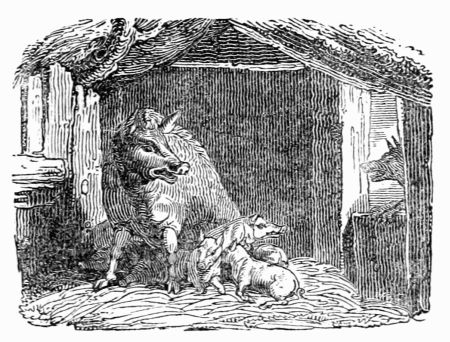
A Sow had just farrowed, and lay in the stye, with her whole litter of pigs about her. A Wolf who longed for one of them, but knew not how to come at it, endeavoured to insinuate himself into the Sow's good opinion: and, accordingly, coming up to her—'How does the good woman in the straw do?' says he. 'Can I be of any service to you, Mrs. Sow, in relation to your little family here? If you have a mind to go abroad, and air yourself a little, or so, you may depend upon it, I will take as much care of your pigs as you could yourself.'—'Your humble servant,' says the Sow, 'I thoroughly understand your meaning; and, to let you know I do, I must be so free as to tell you, I had rather have your room than your company; and, therefore, if you would act like a Wolf of honour, and oblige me, I beg I may never see your face again.'
APPLICATION.
The being officiously good-natured and civil is something so uncommon in the world, that one cannot hear a man make profession of it without being surprised, or, at least, suspecting the disinterestedness of his intentions. Especially, when one who is a stranger to us, or though known, is ill-esteemed by us, will be making offers of services, we have great reason to look to ourselves, and exert a shyness and coldness towards him. We should resolve not to receive even favours from bad kind of people; for should it happen that some immediate mischief was not couched in them, yet it is dangerous to have obligations to such, or to give them an opportunity of making a communication with us.